eral government illegitimate”, Oct. 19 at 10:05 PM, with 2.6M views. It covers the governors memo, the “not secession” line, and Massachusetts, California and Illinois. The
is also attached to it.
, Oct. 20 at 9:34 PM. This includes the ex-USAID officer saying, “we used to be the ones with a lot of money” (see below).
, Oct. 21 at 1:50 PM. This covers the three “emergency” scenarios: militarization, the “election meltdown,” and members of Congress not seated fast enough.
🔥 There were some revealing admissions. In another clip, one retired USAID officer complained about how much harder his work is now, outside of government, instead of from the cushy environs within USAID headquarters.
“We used to be the ones with a lot of money,” he said, “and sharing our model and our guidance and our support.” Fortunately, though, other private funding sources have stepped in to help during this difficult period. “We are really grateful for those of you who are stepping up to provide a similar level of guidance and support for us as we traverse a difficult period here in the U.S.”
The reference to “here in the U.S.” suggested he was speaking for foreign donors. That might become a problem later. But bookmark that.
This raises so many questions. Like, who collected these fired USAID officials when that agency was shut down and tasked them with continuing? Did they work on US-related resistance while they were at the agency as federal employees? In other words, were these people weapons aimed back at us, when they were supposed to be focused on deploying ‘soft power’ against foreign countries? And who exactly is “stepping up to provide a similar level of (financial) support?”
Employing three hundred soft-power color revolutionaries sounds like it needs a whole lot of money.
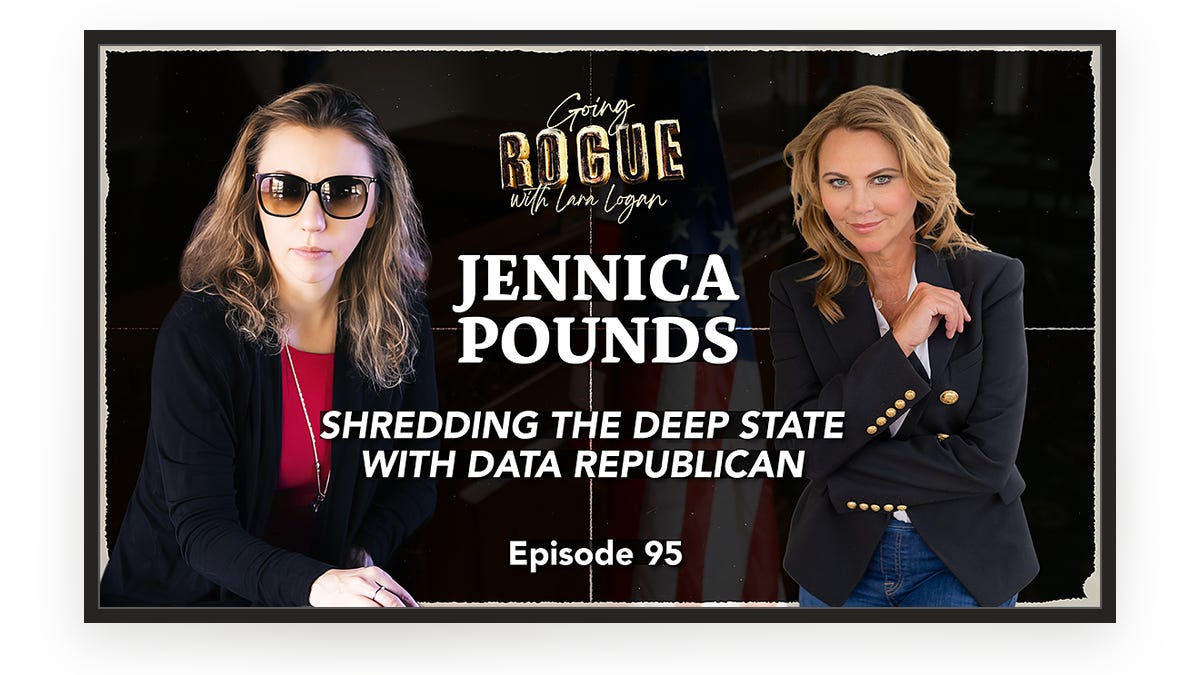
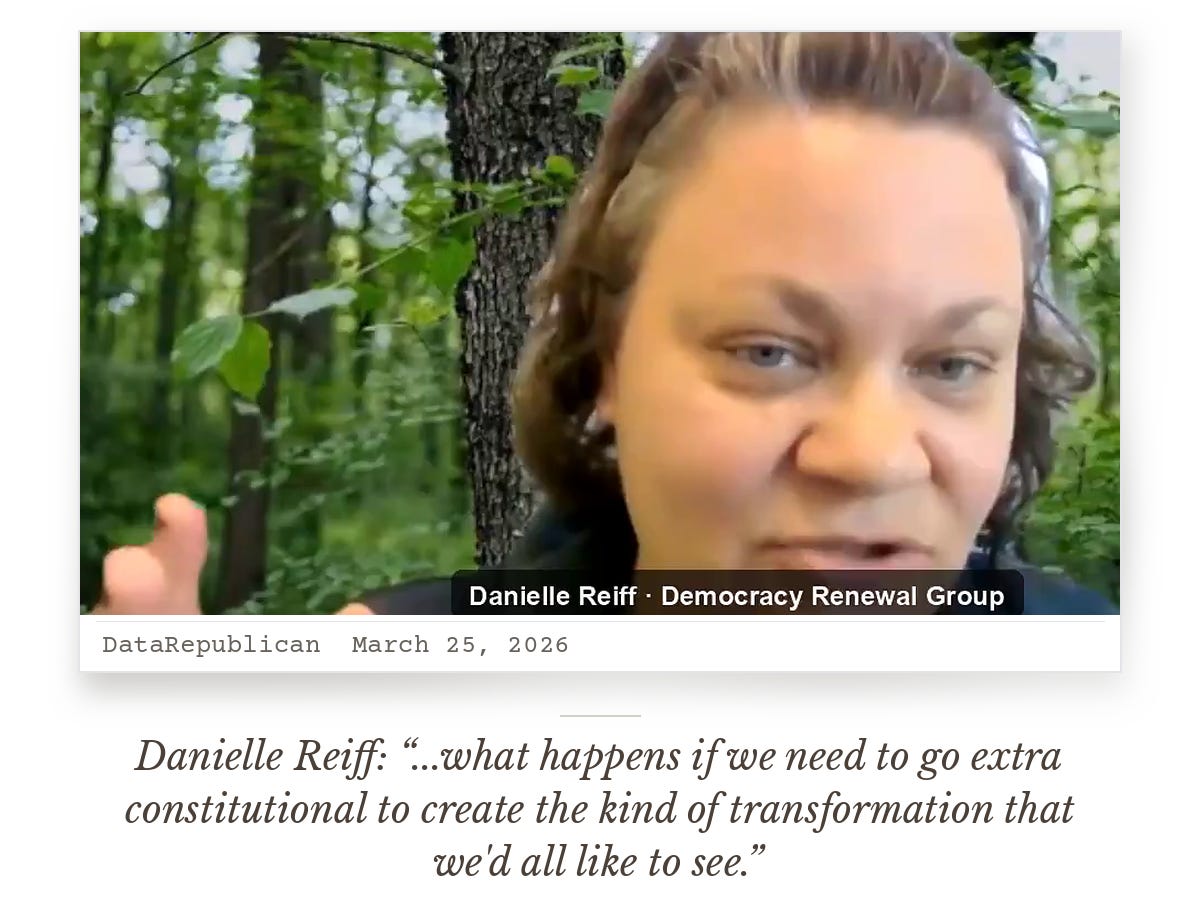
DataRepublican said that she got the recordings from a tip. According to Data, one of the group’s leaders ran an AI note-taker that, apparently, saved everything to a public Google link. “I’ve got a bunch of ‘Chatham House rules, no recordings’ recordings,” Data posted. “Their stupidity is our saving grace.”
Ruh roh, Scooby.
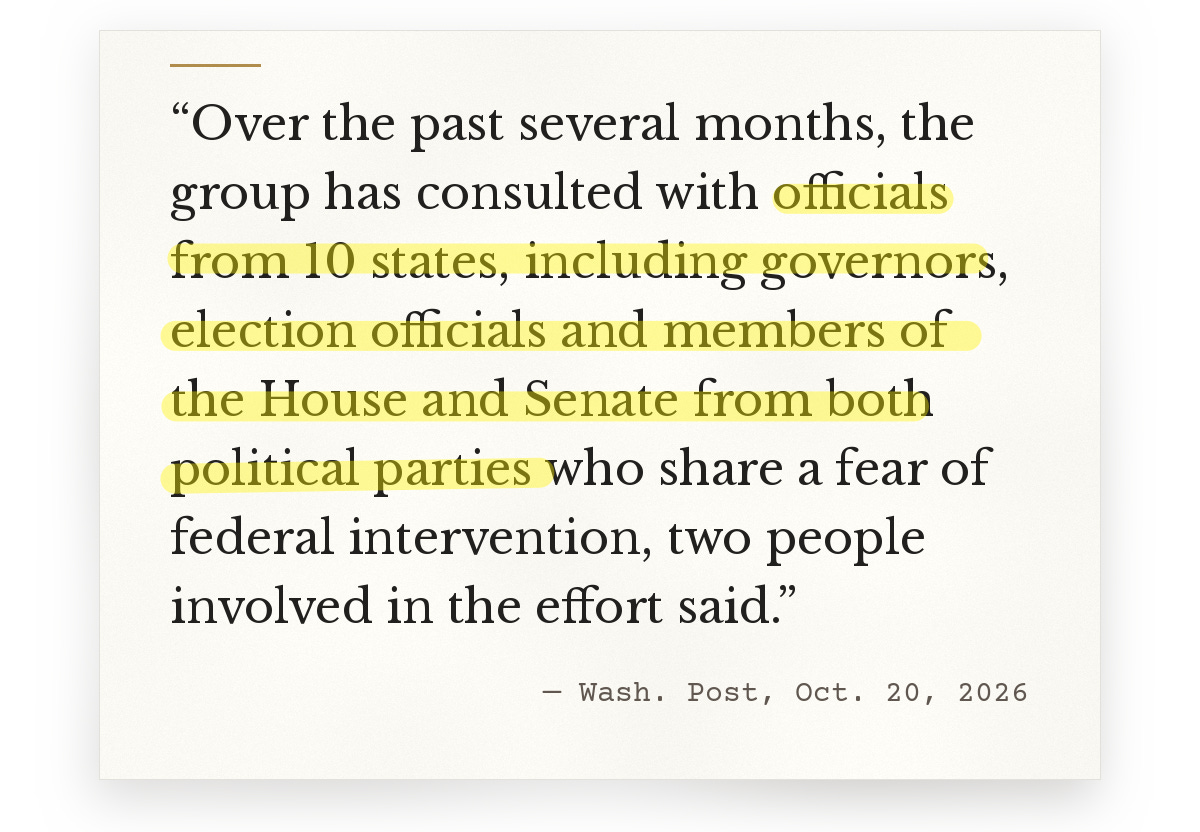
🔥 About 36 hours after the first tapes dropped, the Washington Post ran the story I linked above. It was basically the same story. WaPo essentially confirmed everything DataRepublican had claimed. Except, of course, WaPo told it from the conspirators’ point of view, in which they see themselves as noble resistance fighters struggling to hang on to the last remaining shreds of democracy in a world teetering on global right-wing fascism.
Here’s how WaPo described them: “A small group of U.S. national security officials has been discreetly advising state governments and congressional lawmakers on how to prepare for the possibility that the Trump administration will attempt to interfere in November’s midterm elections,” the Post reported. It described the core group as “about 10 current and former officials with experience in the Defense Department, some of whom have previously focused on countering authoritarianism abroad.” Meaning, more color revolutionaries.
The Post named zero of them. It said they all wished to remain anonymous due to “fear of retaliation.” Uh huh. DataRepublican’s response: “This is how you know my recordings are real and they’re scared. Washington Post already doing counter-messaging.” Others noticed too.
The Washington Examiner’s Byron York pointed out that the Post’s story “is apparently based on the anonymous accounts of two people,” and quoted the Post’s own admission that the officials’ claims were “based on personal analysis of the administration’s activities and public statements… not access to specific government intelligence.”
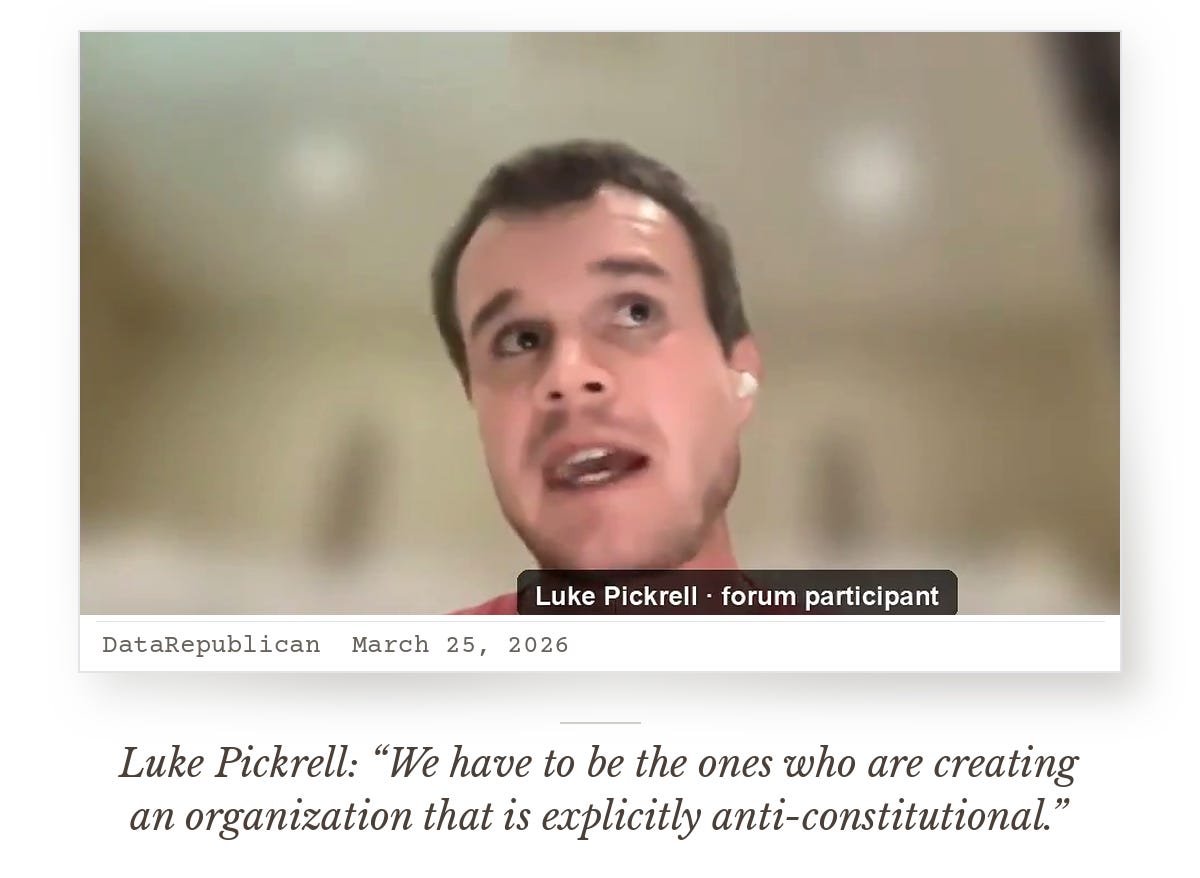
🔥 So … what is their plan? They say it’s not secession. Not actually. “This is not a concept for a secession,” one speaker argued. “No one is talking about leaving the United States.” They say they don’t want out; they just want the steering wheel. But the details suggest something different. It sounds a whole lot like the same kind of talk preceding the 1860s Civil War secession.
For example, one speaker explained that, after a triggering event that “disqualifies” the federal government, making it “illegitimate,” governors would “keep on trying to run the country or at least parts of the country,” “coordinate with each other,” make “outreach to foreign governments,” and “wall off these illegitimate individuals”— meaning, presumably, Republicans.
That sounds like a decent description of the Confederate States of America, doesn’t it?
Let’s consider some similarities. Georgia’s 1850 Platform said the state would stay in the Union, but then listed federal acts that would justify leaving, like repealing the Fugitive Slave Act or abolishing slavery in D.C. That was a written list of triggers. The “red lines” memo mentioned in Data’s video clips —supposedly given to governors— sounds like the same thing.
In what we’ve gotten so far, the activists never say precisely what the red lines are. One speaker said they are still “being refined in terms of indicators and metrics.” But they did mention a couple of examples.
One “red line” they suggested was Trump using the Insurrection Act or seizing voting machines after an election. Another was a legal election, but one where some people don’t like the outcome: “We could have a clean election,” one speaker said, “and then half the country or 25% of the country doesn’t trust the results.”
It reminds us of when President Lincoln was lawfully elected, and some Southern States —“half the country”— didn’t like it.
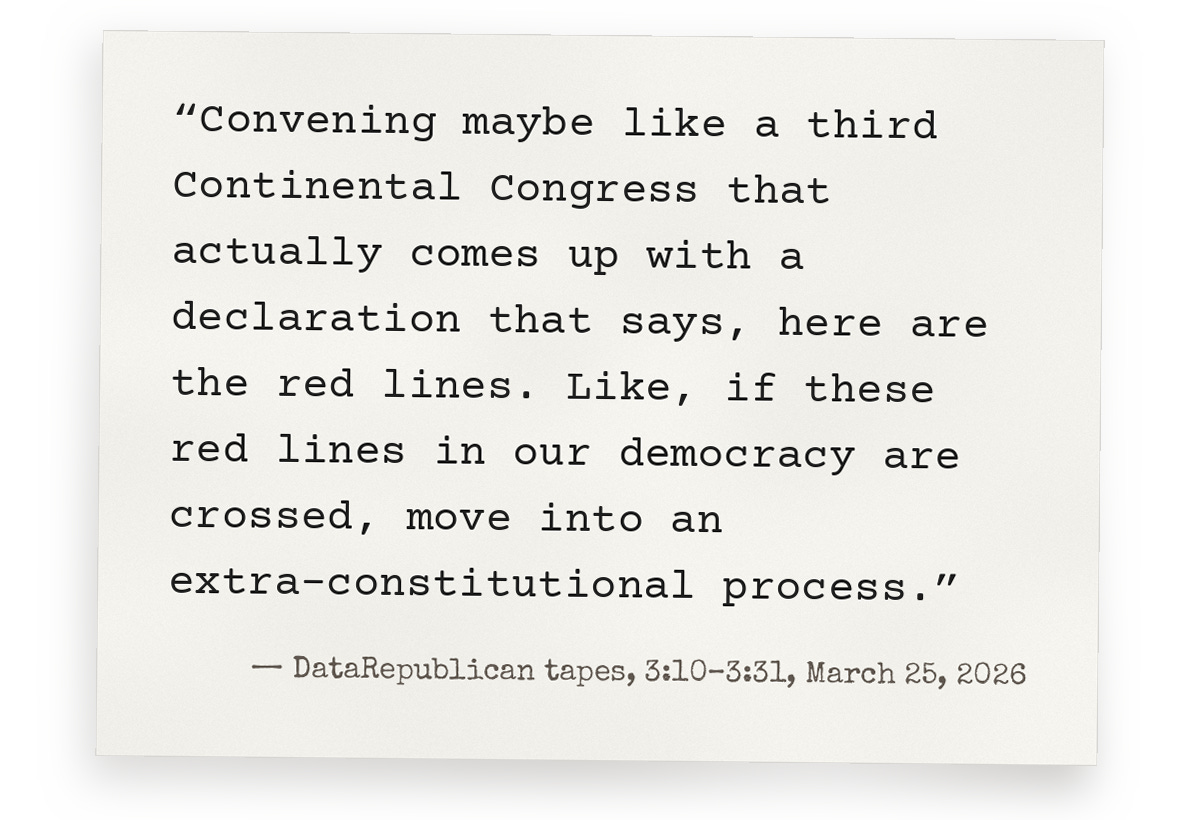
Like revolutionary parrots, they kept repeating how they don’t want secession. But everything they proposed screamed secession. At one point, a speaker called for a third Continental Congress and a “declaration.” Alert readers will recall that the first two Continental Congresses produced a revolution and a declaration of independence from Great Britain.
What did they mean by saying we need a third Continental Congress? Well, in July 1775, three months after Lexington and Concord, the Second Continental Congress issued its Declaration of the Causes and Necessity of Taking Up Arms, which insisted, “We have not raised armies with ambitious designs of separating from Great Britain.” Maybe that wasn’t the ambitious design. But one year later, we were out.
1776 began with reassurances and ended with the business part of a bayonet. Let’s take them at their own word. That is what they meant.
None of this, of course, says anything about whether these nitwits actually have the capability of organizing a brown bag luncheon at a Chipotle, never mind organizing a third Constitutional Convention. So we’d normally ignore them as TDS idiots, except for the troubling reality that they are working with 300 disgruntled ex-USAID color revolutionaries.
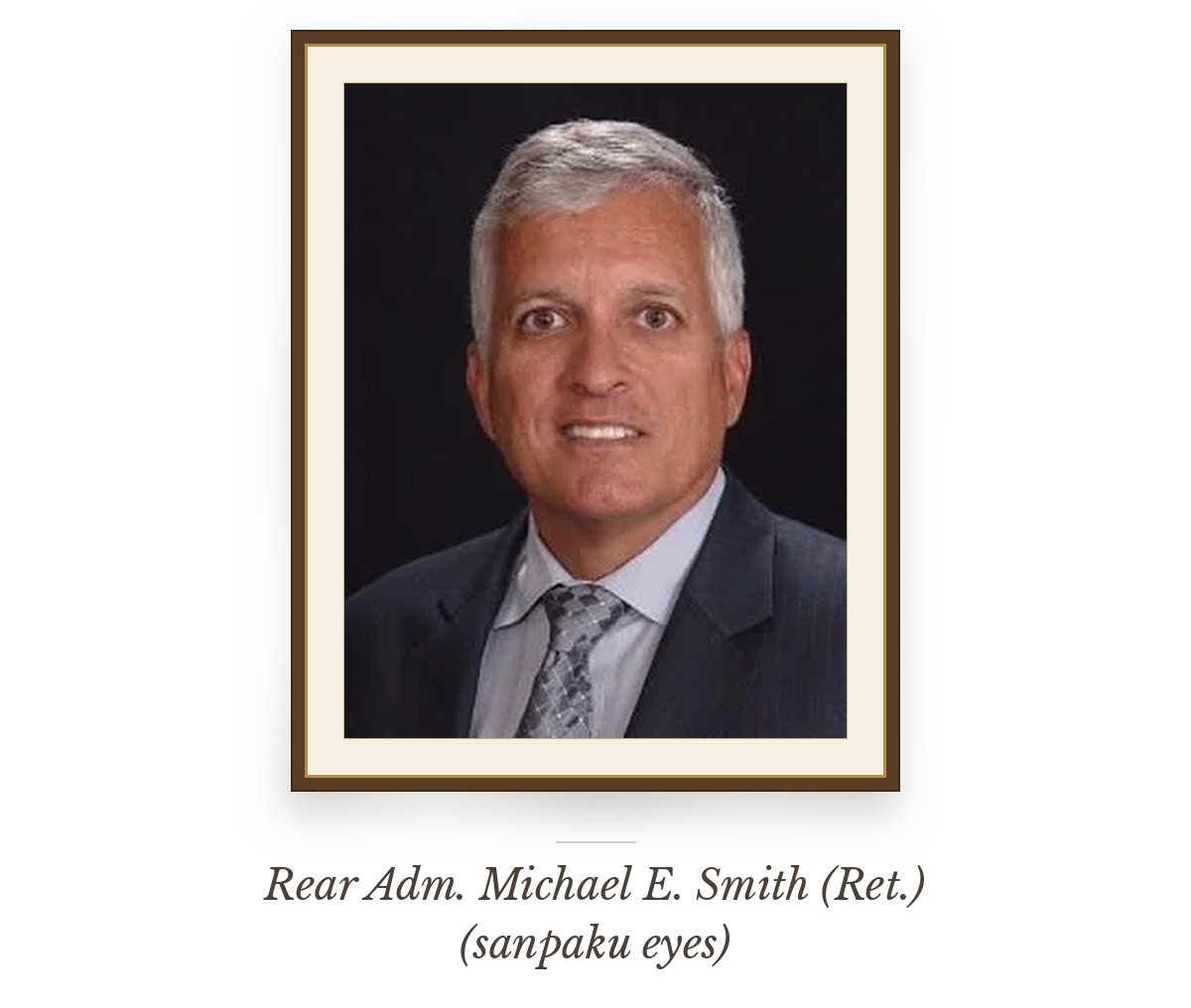
DataRepublican, whose specialty is dot-connecting, has connected the USAID organizers and the activists with even bigger groups of former government officials, including one headed by retired Rear Admiral Mike Smith called National Security Leaders for America (until the election, “for Biden”), which boasts 1,600 former military members.
🔥 There’s much more. But you get the idea. Now, amidst all this highly troubling information, there were some encouraging points.
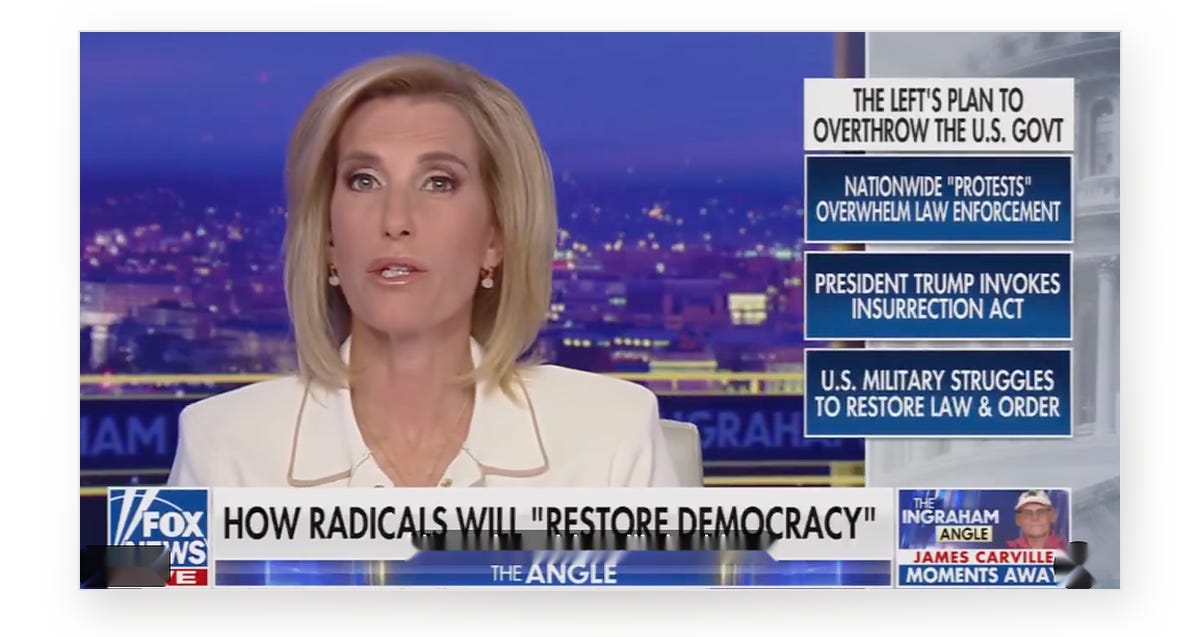
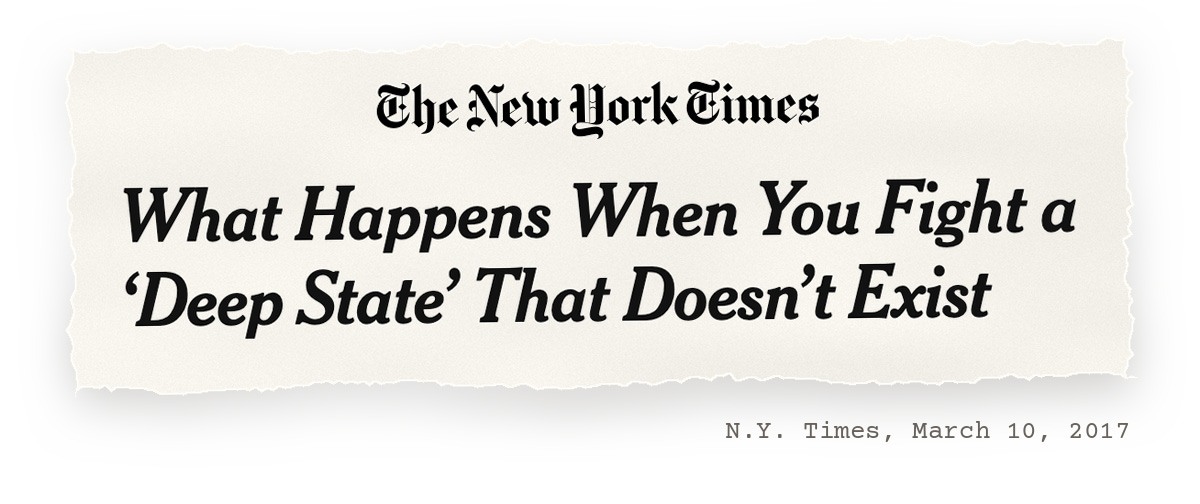
Democrats and corporate media allies have long curled their lips at the very idea of a deep state. They’ve labeled it one of the most durable Trump/MAGA conspiracy theories of all. I believe the New York Times stylebook requires sneer quotes whenever a reporter types “deep state.” Here, for example, is the Grey Lady, right out of the gate in 2017, declaring to the masses from its tall building headquarters that
there is no such thing as a deep state.Well, if federal employees can be fired but then seamlessly continue doing their geopolitical work anyway, with progressive foundations and donor sponsors stepping right into the funding gaps, what else would you call it, if not a ‘deep state’?
Whatever you decide to call it, it persists even after separation from the host. It’s like a parasite or a bad STD.
Fire any normal career bureaucrat, and you’d expect him to update his LinkedIn and take up golf. Instead, these USAID folks got a fiscal sponsor, a foundation grant, and a Zoom link, and kept right on running regime-change ops. Only now the target regime is ours.
If that isn’t a deep state, it’s at least a deep state alumni association, with dues paid by Arabella and the Ford Foundation.
Here’s the good news. By their own sad complaints — “We used to be the ones with a lot of money”— they are now operating outside the government, which is a vast improvement. The parasites are still alive, but at least they’ve been surgically removed from the victim. And now they must use private money, so we no longer experience the insult of them using our own money to injure us.
DOGE did, in fact, hurt them. Probably badly. Hopefully fatally.
Beyond that, well, thanks to DataRepublican, their conspiracy just got outed before they were ready. As Supreme Court Justice Louis Brandeis once said, “Sunlight is the best of disinfectants.” (Along with liberal amounts of Clorox.) Their plan depended on secrecy, as evidenced by their repeated comments like, “while we’re in the safe space here,” “we’re not publicizing this,” and switching off the recording for the Q&A.
But now the whole thing is out in the open. It’s subject to the harsh gaze of public scrutiny, two weeks before the midterms. The blue state governors will be asked about it. FOIAs will ensue. And it landed in October. By surprise. (Just saying.)
Any secret ‘contingency plan’ that’s been exposed before any of the contingencies happen is a lot harder to use effectively. And best of all: it opens up their potential criminal liability before they were ready.
🔥 Their exposure is much worse than they think. True, the conspirators have been very careful. As though coached by lawyers, every few minutes, while describing inevitable violence and secession, they kept insisting they aren’t advocating for violence or calling for secession.
And then they go right back to doing it. But there’s a reason for all their plaintive denials. They think it immunizes them.
Seditious conspiracy (18 U.S.C. § 2384) requires a plan to use force against the government, and the First Amendment, under Brandenburg v. Ohio, protects even radical activism unless it’s aimed at imminent lawless action. Daydreaming on Zoom about a Third Continental Congress is not a crime. These are careful people, and they built their plan to stay right inside the legal part. Sure, they conspire to overthrow the government, talk about the ‘red lines,’ and write the memos, but they let someone else do the actual crossing.
That’s how color revolutions work. But prepare for irony. The left already rewrote the rulebook. Here comes the boomerang again. Duck! You are going to love this part.
🔥 Remember special counsel Jack Smith, the weird-looking lawyer leftists love? When he went after Trump, he faced the same problem: alleged insurrectionary behavior without violence. So Smith helpfully indicted the former president under 18 U.S.C. § 241 (conspiracy against rights) and § 371 (conspiracy to defraud the United States). Neither statute requires a single act of violence.
Smith was thrown out for being unconstitutionally appointed before his legal theory could be tested. But the theory was that coordinating a plan to declare an election illegitimate and encouraging state officials to act on it was itself the crime of insurrection— even though Trump was never involved in or encouraged any violence. (He actually discouraged it.)
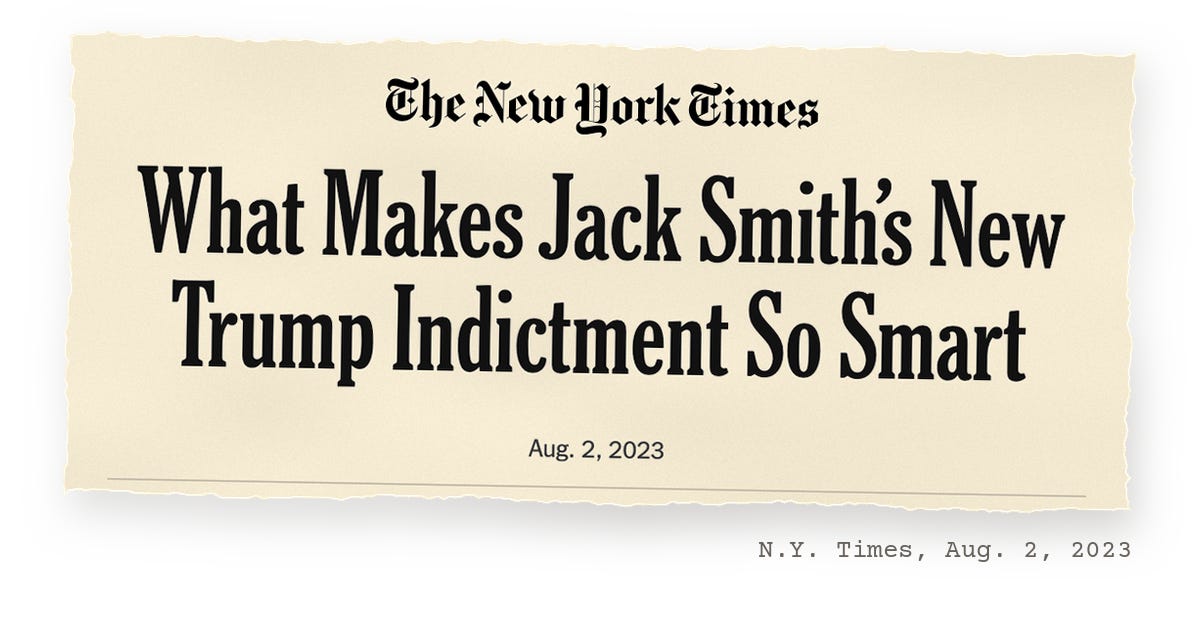
I’m sure the Democracy Renewal Group’s members remember this theory well, since at the time they cheered prosecutor Smith on till they were hoarse. Not just them. Behold! In August, 2023,
the New York Times platformed Smith’s creative legal theory as so smart:
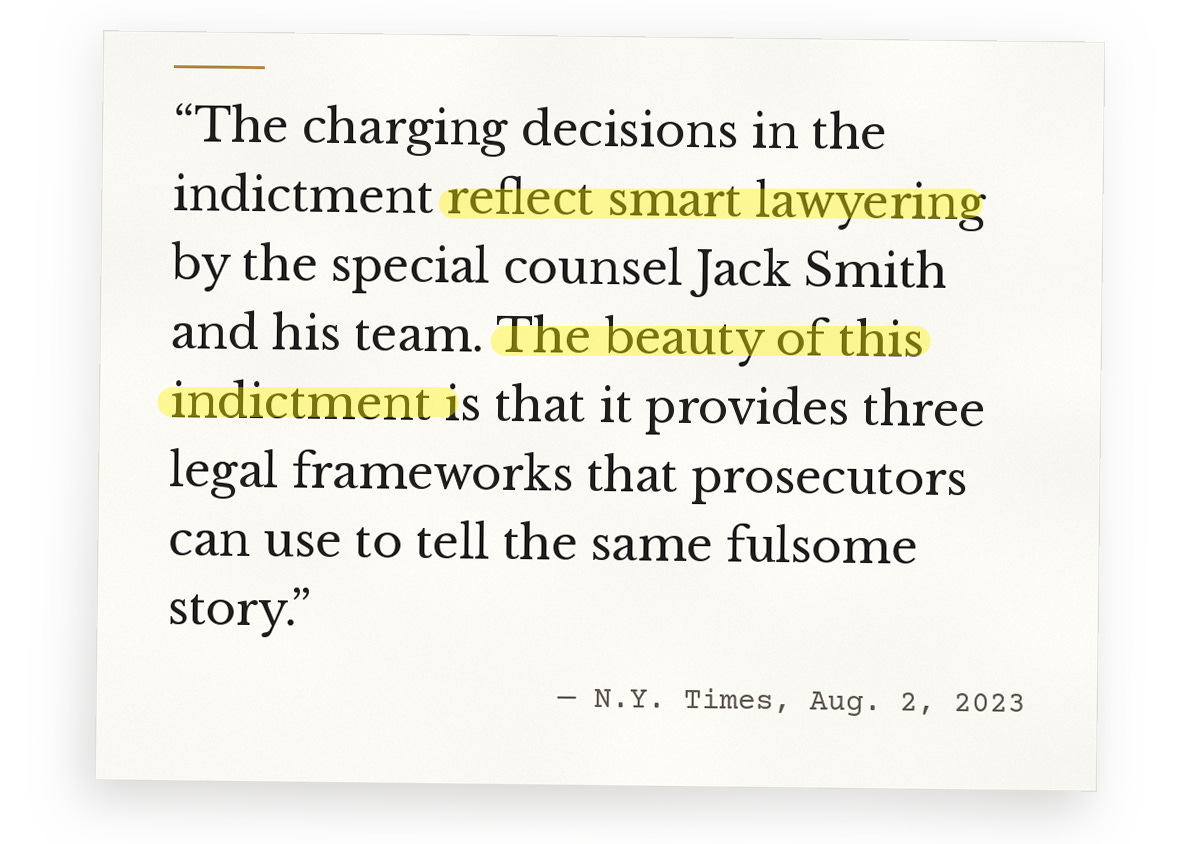
The op-editors crisply deemed it “smart lawyering,” and even described the way Smith charged Trump as beautiful:
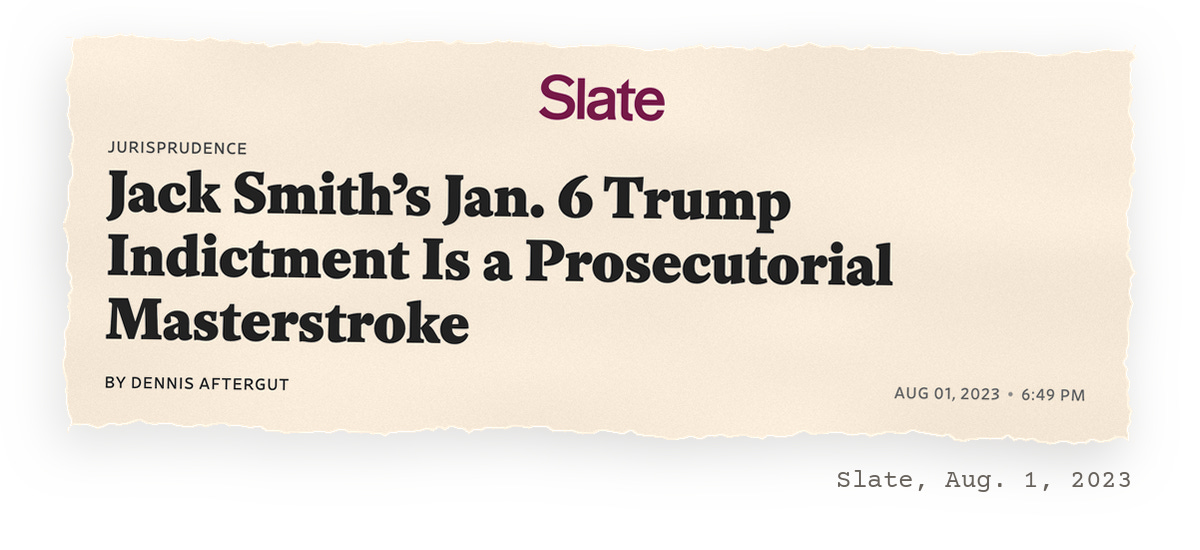
There was more. Virtually all of corporate media swooned over Jack Smith’s cleverness. No adjective was spared!
Here’s Slate’s August 2023 headline, calling Smith’s charges a “masterstroke”:
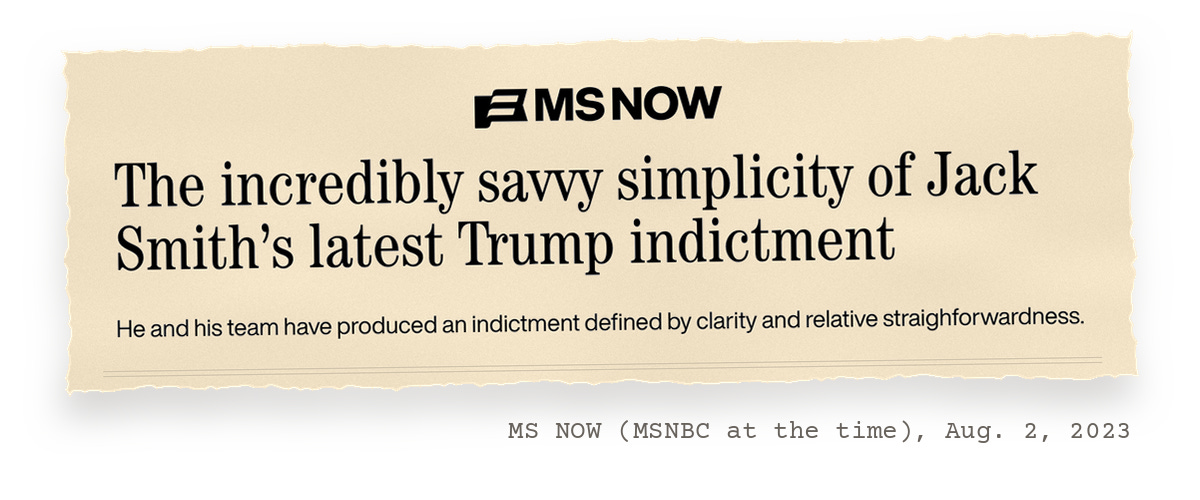
And finally, MS NOW (then MSNBC) surpassed those with the “incredibly savvy simplicity of Jack Smith’s latest Trump indictment.” Not just savvy. Incredibly savvy. This embarrassing effort was penned by none less than Norm Eisen himself, who served as the House Democrat’s special counsel during Trump’s first impeachment, and currently runs a giant lawfare shop boasting more than 250 legal cases against the Trump Administration.
So it’s going to be very hard for them to complain if the DOJ deploys the “smart,” “beautiful,” and “savvy” Jack Smith standard against all the folks involved in the group that just admitted it is getting up to stuff ten times worse than whatever Trump was accused of doing.
In other words, DataRepublican has exposed a network that drafts an “options memo” for governors to “wall off” a lawfully elected federal government, pitches it to at least three identified governors, and stands up a “war room” for election night.
It all looks remarkably like what Jack Smith called a seditious conspiracy when he charged a former president.
Beyond Jack Smith’s “smart” theory, the Insurrection Act (10 U.S.C. § 253) doesn’t require any actual riots either. It covers any “unlawful combination, or conspiracy” that obstructs federal law, which is a fair description of governors refusing federal authority and making treaties with foreign governments. This reminds us of the Constitution’s Article I, Section 10, which bars states from making “any Agreement or Compact… with a foreign Power” without Congress’s consent, and the plan’s “outreach to foreign governments” looks more like sedition than suggestion.
Now, I am a lawyer. But I’m only a commercial litigator. I’m not a DOJ prosecutor who has to bring a case. I could be missing something. But it is beyond my ability to understand how President Trump could be charged as an insurrectionist for holding a rally, but not these conspirators. And the former military members, who remain subject to military justice, might have even bigger problems (I’m looking at you, Admiral Smith, and your googly Sanpaku eyes).
In short: they might want to lawyer up.
Thus, while all this is undoubtedly a wake-up call that demands close attention, it is also a massive success to celebrate. It proves Trump and DOGE badly damaged the deep state and its progressive allies— and removed them from their much more dangerous position inside government.
In one fell blow, DataRepublican has sent the conspirators back to their electronic drawing boards.
It almost seems unfair. One deaf software engineer from Utah spoiled the careful plans of 300 ex-USAID color revolutionaries, a 1,600-member flag-officer network, the Democratic Socialists of America, and the Washington Post’s anonymous sources— all in under a week. And consider this— Data now says she has thousands more transcripts and videos. I wonder what else could be buried in there.
Finally, and as a nifty segue from yesterday’s post, in classic Scooby-Doo fashion, DataRepublican just tore the mask off the villain, showing the audience that Admiral Smith (Ret.) isn’t actually a terrifying monster. He’s just an angry old man with a bad spray tan and weird eyeballs.
Right in time for Halloween, too." .......

.jpg)
.jpg)