(from our archives, 2003:)
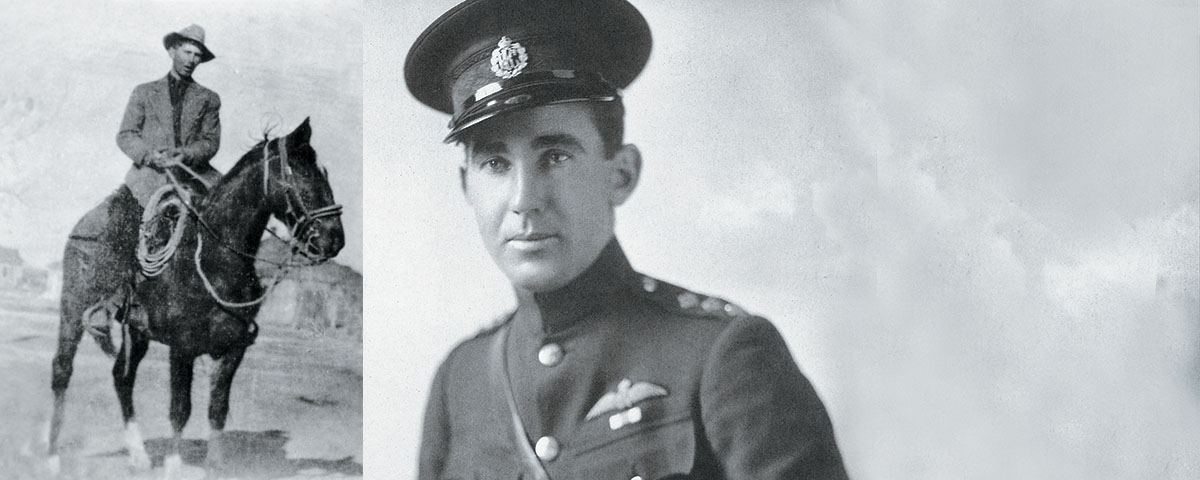
"Horses Don't Fly"--but cowboys do. At least, Frederick Libby did.
A century ago, he was a young cowboy from Colorado. His wanderlust took him to Canada, where he joined the Canadian Army as a truck-driver, never having driven a truck before. This was back when Canada acted like a real country. Sent to France, he joined the Royal Flying Corps as an "observer", the 2nd man in the 2-man crew who acted as gunner/bombardier/navigator/photographer. He shot down a German plane on his first time out, and eventually had some two dozen 'kills', becoming a pilot himself in the new single-man aircraft.Capt. Libby speaks in a Twain-esque voice, although as a Westerner, he's quicker to the point than the Southerner Twain.
You may ask "Why would I care about this book?"
Well, as Cicero said; "Not to know what has been transacted in former times is to be always a child. If no use is made of the labors of past ages, the world must remain always in the infancy of knowledge."
And we already have gobs & gobs of middle-aged children. Please refrain from being one. Thank you.
Plus, it's funny. Capt. Libby says things like "There are no bad horses; only bad people." and "The French mademoiselles are all for winning the War; they are with you down to their last chemise." This was back when French men still had hair under their arms...and French women didn't.
If you read it, you'll learn what Capt. Libby thought of the "Red Baron", meeting Billy Mitchell and that demon Wilson's "Making the World Safe for Democracy".
He was presented the Military Cross by King George for his bravery.
And that's something we all could use these days." .......
 |
About the Author
"Fredrick Libby has given us a very readable and interesting memoir from 1896 to 1918. I do not know if Mr. Libby was a typical westerner of his time, but he is instantly likable, mischievous, and straightforward, with a joy for living. Libby is also writing about a time that was slowly disappearing, and by 1920, most of it would be gone. But to him and his family and friends the encroachment of the modern is a slow and unseen process. He gives us the view of life on the plains, out west, with ranchers still herding horses, cattle, sheep, before mechanized stockyards; the railway is there, but motorcars are still few. Libby loves this outdoor life, and he is not the intentional rugged individual, he is an individual that has deep affection for his family. They are not subsistence ranchers, but comfortably middle-class, except they work with their hands, and are extremely mobile, no one complains about a job taking them away for months. Libby himself is very flexible moving from the role of rancher-cowpuncher to a pilot, controlling the most primitive to the most highly technological inventions of man. And even Libby is amazed that in morning he is an infantry private, by afternoon an observer flying a combat mission, and in twenty days a second lieutenant. And Fred is ready for the challenge. We go on patrol with him and his pilots, all young, immortal, and without fear, even with death all about them. In total, a great book about two cultural landscapes that one man successfully strides across.""Frederick Libby tells his own story here - almost as if he never really intended it for anyone but family, friends, & descendants. His style takes some getting used to, but especially when he begins to recount his flying experiences -- that's when the story really gets good. The reader also gets a fascinating glimpse of what it meant at that time to be "American"...and "a gentleman". Libby seems utterly guileless & sincere. His story reveals a timeless understanding of the nature of war, the friction between the politicians who decide to make war & those who actually fight. He leads an extraordinarily dangerous life that just seems to scream that he won't live past 18! He survives many peacetime & wartime scrapes & lives to be 78. The disappointment with his story doesn't have anything to do with his writing but involves the shabby way he was treated by his own government even after distinguishing himself in the war. There was no "U.S. Air Force" per se, & he was encouraged by the U.S. in the latter stages of the war to help start an American fweep him along (mostly in safety). He's much smarter than Forrest, true. His father actually bets him (in jelying squadron. He had fought for two years as a flyer with England's Royal Flying Corp -- doing an absolutely brilliant job. He was recognized by the King no less! He accepts the offer by the U.S. and his experience & talent is utterly squandered. Ironically, the decision may have saved his life by getting him away from the Western Front.""An excellent read. Libby's memoir is full of fascinating detail about his prewar and wartime activities with horses and planes. A good shot, he was a talented observer and pilot with a string of victories to his name.One quibble - there is a very inaccurate note about Max Immelmann in the latter half of the book. He was Max, not Hans, Immelmann, he shot down 15 Allied aircraft, not 6, and it is now generally thought that his engine and gun synchronizing gear was damaged causing his plane to shake itself apart, rather than the wings being shot away. He was also awarded the Pour Le Merite at the same time as Boelcke, but was effectively the first fighter ace as he gained 5 victories before Boelcke matched his score.Not sure if the note was added by an editor or by the author but it is fundamentally wrong. Otherwise this is a must-read for those with an interest in WW1 aviation." .......
" ...The American’s remarkable RFC career ended in September 1917 when, at the request of Colonel Billy Mitchell, he was transferred into the U.S. Air Service. After a fundraising tour, highlighted by the auction of his Stars and Stripes wing streamers for Liberty Bonds at Carnegie Hall in New York City, he was assigned to the 22nd Aero Squadron at Hicks Field.
Unhappily, a spinal disability ended Libby’s flying career and troubled him for the rest of his life. Nevertheless, this remarkable man raised a family in California, made and lost fortunes in oil exploration and celebrated his 65th birthday with a flight in a supersonic U.S. Air Force jet.
Nor did the British forget Libby. In 1963 his former CO, Sholto Douglas, by then Marshal of the RAF and Lord Douglas of Kirtleside, recalled in his memoir Years of Combat: “An American youngster by the name of Frederick Libby, who had disguised himself as a Canadian, joined me at Treizennes as a pilot in No. 43 Squadron at the time of the Battle of Arras. Libby served with the Royal Flying Corps during the worst period in our fortunes and one afternoon not long after coming to us he shot down his first enemy aircraft which crashed just to the east of Vimy Ridge.”
Captain Frederick Libby, MC, America’s first ace and the first man to fly his country’s flag over German lines, died in Los Angeles on January 9, 1970, at age 77." .......
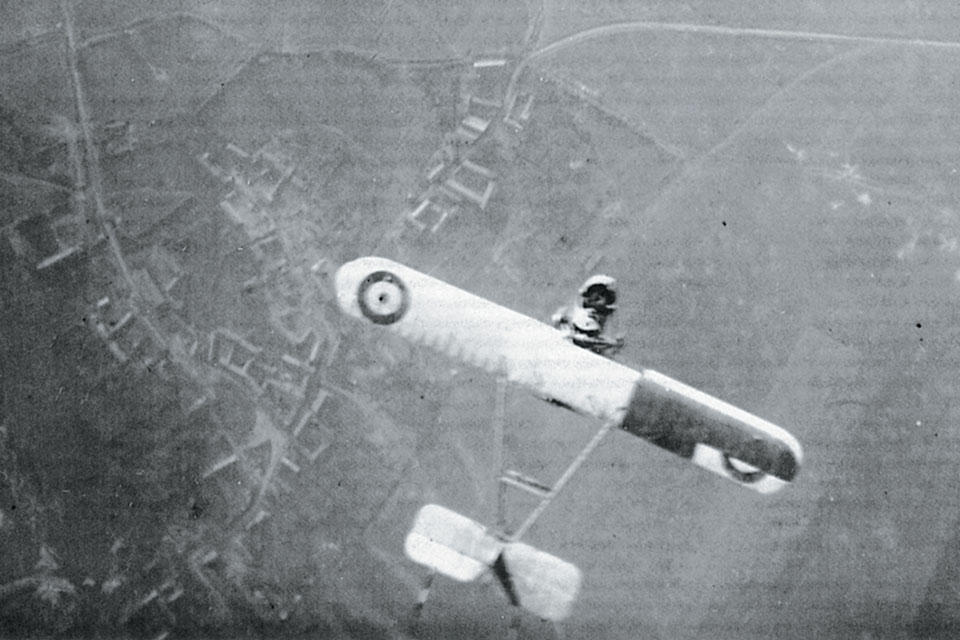 |
| On September 23, 1916, Price and Libby fly a replacement F.E.2b—with a hastily repaired upper wing following a crash the previous day—over Bapaume, France. (National Archives) |
From Library Journal
But Herr Zelensky is being paid by the CIA/Globalist Cabal to depopulate Ukraine. If they can’t steal Russia, they’ll settle for Ukraine. DEAD Ukrainians are a Feature, not a Bug.
"...it is of infinite moment that you should properly estimate the immense value of your national union to your collective and individual happiness; that you should cherish a cordial, habitual, and immovable attachment to it; accustoming yourselves to think and speak of it as of the palladium of your political safety and prosperity; watching for its preservation with jealous anxiety; discountenancing whatever may suggest even a suspicion that it can in any event be abandoned; and indignantly frowning upon the first dawning of every attempt to alienate any portion of our country from the rest, or to enfeeble the sacred ties which now link together the various parts.
For this you have every inducement of sympathy and interest. Citizens, by birth or choice, of a common country, that country has a right to concentrate your affections. The name of American, which belongs to you in your national capacity, must always exalt the just pride of patriotism more than any appellation..."
Thank you for your attention to this matter

No comments:
Post a Comment