Isaiah 1:
The Degenerate City
21 How the faithful city
has become a prostitute!
She was full of justice;
righteousness lodged in her,
but now murderers.
22 Your silver has become dross,
your wine mixed with water.
23 Your princes are rebellious
and companions of thieves;
everyone loves a bribe
and follows after rewards.
They do not defend the fatherless,
nor does the cause of the widow come before them.
24 Therefore the Lord, the Lord of Hosts,
the Mighty One of Israel, says:
Ah, I will get relief from My adversaries,
and avenge Myself on My enemies.
25 And I will turn My hand against you,
thoroughly purge away your dross,
and take away all your impurities.
26 I will restore your judges as at the first,
and your counselors as at the beginning.
Afterward you shall be called
the city of righteousness,
a faithful town.
27 Zion shall be redeemed with justice
and her converts with righteousness.
28 But the destruction of the transgressors and sinners shall be together,
and those who forsake the Lord shall be consumed.
Yes, Lord of Angel Armies!
 |
Chief!
WATCH LIVE: Supreme Court Justice Clarence Thomas Delivers Lecture at UT Austin--excerpts:
"...Do any of us have what it took for our young soldiers to storm Normandy Beach, to fight at Guadalcanal, to later fight at Chosin Reservoir?
If we can't say that we have the courage required of these young soldiers in battle to defend our founding principles, then how do we preserve these principles and this Republic? Until we have a devotion that matches the courage of those who made this country possible, I seriously doubt any amount of study or development of insights about our Constitution will make much difference.
And the structure and limited role of government is to assure that it does not exceed the authority to which we have consented or intrude on our natural rights. The Constitution is the means of government. It is the Declaration that announces the ends of government.
 |
Since Wilson's presidency, progressivism has made many inroads into our system of government and our way of life. It has coexisted uneasily with the principles of the Declaration. Because it is opposed to those principles, it is not possible for the two to coexist forever.
Progressivism was not native to America. Wilson and the progressives candidly admitted that they took it from Otto von Bismar's Germany whose state centric society they admired. Progressives like Wilson argued that America needed to leave behind the principles of the Founding and catch up with the more advanced and sophisticated system of relatively unimpeded state power nearly perfected.
He acknowledged that it was a foreign science speaking very little of the language of English or American principle which offers none but what are to our minds are alien ideas. He thus described America still stuck with its original system of government, quote, "slow to see the superiority of the European system".
To Wilson, the unalienable rights of the individual were, quote "a lot of nonsense". Wilson redefined Liberty not as a natural right antecedent to the government but as, quote "the right of those who are governed to adjust government to their own needs and interests".
 |
| Klanbake: The Wild Story of the 1924 Democratic Convention - Commonplace Fun Facts |
Progressives such as John Dewey attacked the Framers for believing that their ideas were immutable truth, good for all times and places, when instead they were, according to him, historically conditioned and relevant only in their own time.
Now Dewey and the Progressives argued those ideas are to be displaced. Progressivism seeks to replace the basic premises of the Declaration of Independence and hence our form of government. It holds that our rights and our dignities come not from God but from government. It requires of the people a subservience and weakness incompatible with a constitution premised on the transcendent origin of our rights.
You will not be surprised to learn that the progressives had a great deal of contempt for us, the American people. Before he entered politics, Wilson would describe the American people as quote "selfish, ignorant, timid, stubborn, and foolish". He lamented that we do too much by vote and too little by expert rule. He proposed that the people be ruled by administrators who use them as tools. He once again aspired to be like Germany where the people he said admiringly were docile and acquiescent.
The century of progressivism did not go well. The European System that Wilson and the Progressives scolded Americans for not adopting, which he called nearly perfect, led to the governments that caused the most awful century that the world has ever seen.
Stalin, Hitler, Mussolini and Mao all were intertwined with the rise of Progressivism and all were opposed to the Natural Rights on which our Declaration is based.
Many progressives expressed admiration for each of them [the dictators] shortly before their governments killed tens of millions of people. It was a terrible mistake to adopt Progressivism's rejection of the Declaration's vision of universal unalienable Natural Rights. Wilson's claim that Natural Rights must give way to historical progress could justify the greatest mistake in our history.

Progressives believed that Darwinian science, the idea of ever advancing progress written into biology itself, had proven the inherent superiority and inferiority of the races. It was only a small step for Wilson to re-segregate the federal workforce. It was only another step for the government to launch sterilization programs on those deemed by the experts of the day to be unfit to reproduce, upheld by my court in Buck v. Bell in an opinion written by no less a figure than Justice Oliver Wendell Holmes.
We can argue over whether you We can argue over whether you believe in immutable absolute Natural Rights or the Wilsonian idea of ever progressing history. Indeed, your school of civic leadership was created to host just such arguments. But let me ask you to consider the consequences.
None of this, of course, was an improvement on the principles of the Declaration.
Progressivism, in other words, is retrogressive. As Calvin Coolidge said on the 150th Anniversary of the Declaration, and I quote,
"If all men are created equal, that is final. If they are endowed with inalienable rights, that is final. If governments derive their just powers from the Consent of the Governed, that is final. No advance, no progress can be made beyond these propositions." |
 |
| Chief! |
"It is rather for us to be here, dedicated to the great task remaining before us, that from these honored dead, we take increased devotion to that cause for which they gave the last full measure of devotion. That we here highly resolve that these dead shall not have died in vain, that this nation shall have a new birth of freedom and that this government of the people, by the people, and for the people shall not perish from the earth."
We could get into debates over whose conception of the Founding is better, over how we are so much better than our Founders were, over what we would do differently. We could be careful to not do anything that exposes us to criticism, costs us friends, or hurts our career prospects.
Each of you will have opportunities to be courageous every day. Whether your calling in life is as a day laborer, a stay-at-home mom, a small business owner, an educator, an office worker, a judge, or some other endeavor.
It may mean speaking up in class tomorrow when someone around you expects you to live by lies. It may mean confronting today's fashionable bigotries such as anti-Semitism.
It may mean standing up for your religion when it is mocked and disparaged by a professor. It may mean not budging on your principles when it will entail losing friends or being ostracized.
It may mean running for your school board when you see that they are teaching your children to hate your values in our country. It may mean turning down a job offer that requires you to make moral or ethical compromises.
One thing I do know to be true, it will mean waking up every day with the to withstand unfair criticism and attacks. These are the choices that we will confront that will confront you and you must decide whether to respond with timidity or with courage as the Signers of the Declaration did. It will of course not be easy. Never is. But if like me, you need a greater source of strength than yourselves, you will need to rely on your faith to guide and to sustain you through it all. You will disappoint people you thought were friends and endure personal attacks as well as attacks on those you care about.
But if you stand, you will find that courage, like cowardice, can be habit forming and it will become a part of your life and a part of who you are. And I may dare say it is liberating. You will also be a living example for others to emulate. So by all means, celebrate the Declaration of Independence. It is the most important act of American history. the foundation of our Constitution and as Lincoln said, the sheet anchor of our Republic.
Thank you, and may God continue to bless our country." .......
Rest in the Vine: The Real "No Kings!"- Moments in American History
Rest in the Vine: "The Declaration of Independence" by Justice Clarence Thomas (2021)
Rest in the Vine: Justice Clarence Thomas and 'Kelo': A CONSTITUTIONAL GIANT IN THE LAND OF LILLIPUT
Joshua 1:9
Have I not commanded you? Be strong and courageous. Do not be afraid; do not be discouraged, for the Lord your God will be with you wherever you go.”
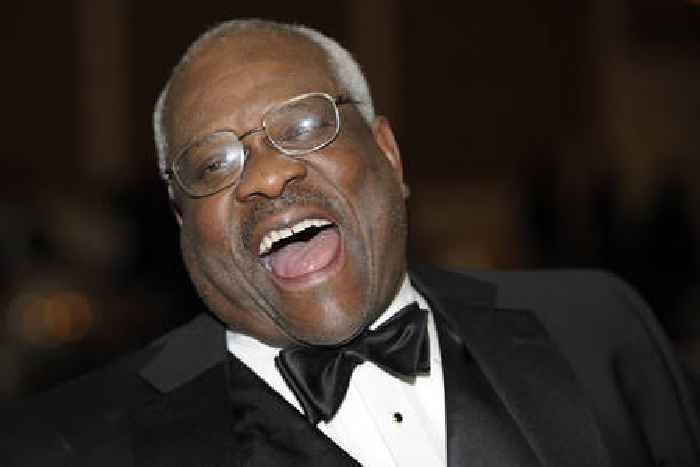
Chief!


No comments:
Post a Comment