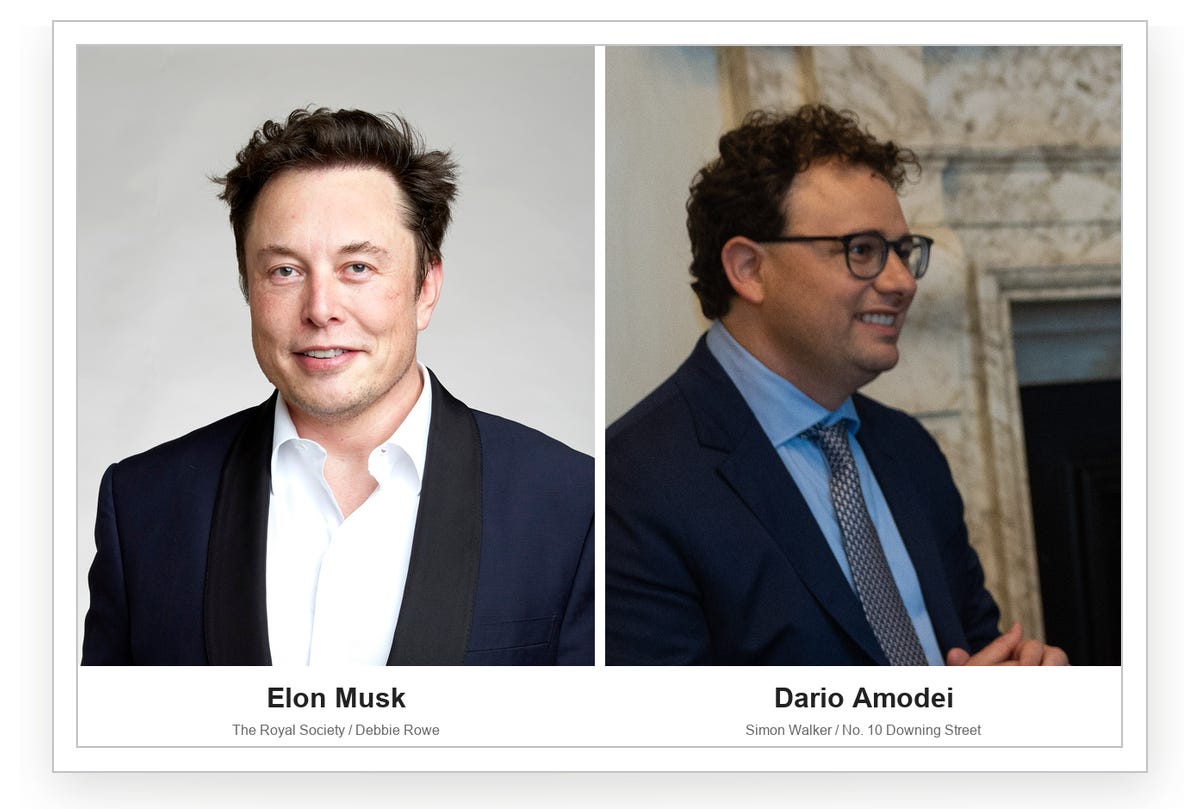
"Today’s top story is both exciting and hilarious. The Wall Street Journal reported, “Musk Vows to Give Each U.S. Child a SpaceX Share.” That was the exciting part. The hilarious part appeared just below that, in the article’s subheadline: “Pledge comes after Anthropic promised to commit 5% of its shares to a new ‘public benefit fund.’” Behold: the philosophical battle of the T-Rexes— the showdown between the individual freedom of capitalism and the collective shackles of progressivism.
“Next year, I will give one of my SpaceX shares to every kid in America,” Musk tweeted early this morning. He hinted at even more.
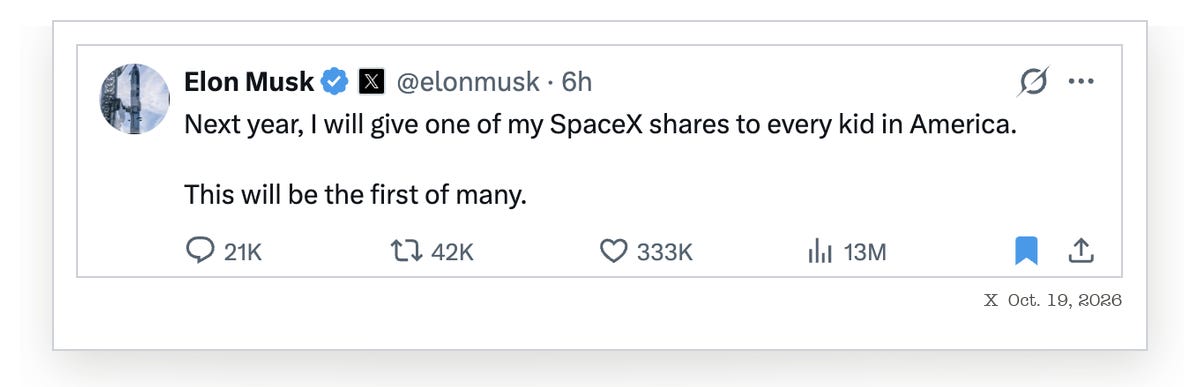
This was terrific. And it was conveyed in a short, declarative sentence that seemed pretty clear to normal human ears, and thousands of Twitterers got the gist just fine. But, you see, our ears were not trained by four years of Ivy League journalism schools.
So Musk’s tweet baffled the highly credentialed Journal editors. What exactly did he mean by, ‘in America’? Does Palm Beach count? What about the Corn Belt?
“It wasn’t immediately clear,” the Journal complained, like an autistic compliance officer, “how the shares would be distributed, who would receive them and when it might start.”
Gosh. The Journal’s many questions provoked questions of my own— but not about Musk’s promise. About the Journal’s sanity.
Did it really ask, “Who would receive them?” What, pray tell, was so hard to understand about the words, “every kid in America?” And, When it might start? Did the words “next year” give the Journal any clues? As for how the shares would be distributed, it seems obvious to me that Musk will do it through Trump Accounts. How this possibility failed to occur to the writers was beyond my ability to understand, since the article mentioned Trump Accounts two paragraphs later.
Maybe the reporter imagined Musk might drop the stock certificates onto kids out of the back of a flying car, or possibly have Optimus robots in tuxedos personally deliver them by hand. (Or if not delivered ‘by hand,’ then ‘by gripper,’ or however we are saying it these days).
Anyway, after scratching its head in confusion over those insoluble enigmas, the Journal did some math. It explained to readers that, with about 73 million children under 18 in the US, Musk’s gift would come to roughly $10 billion at today’s stock price.
🔥 After trying to manufacture as much ‘news’ about Musk’s one-line tweet as it could, the Journal then turned to the competing ‘gift.’ It was from AI giant Anthropic, whose progressive CEO Dario Amodei is lately begging the federal government to regulate his industry. Anthropic’s board includes lefty heavyweights like Democrat megadonor Reed Hastings, and its governing trust includes the Clinton Health Access Initiative, which you can be sure has nothing to do with health.
Over the weekend, Anthropic announced that when (if) it goes public, it “plans” to pledge 5% of its shares, and I am not making this liberal gobbledygook up, to a “public benefit fund” with the “flexibility to make charitable donations” or to give money directly to “specific populations.” The company said details were forthcoming, but it would be a wholly-owned, for-profit LLC— providing a level of flexibility approaching that of an Olympic gymnast.
In other words, Anthropic distrusts ordinary Americans with its generosity. It doesn’t even want to be bound by 501c3 rules. Even after ‘giving’ it, Anthropic will keep control of the money, and decide who gets it and what they can use it for. And when it says “charitable donations,” it means NGOs. When it says “specific populations,” it means progressive victim groups. (One presumes, for example, that pro-life groups need not apply.)
But Anthropic won’t tell us who it will “gift” the money to, not yet; it will let us know later. Trust us.
Influencer DataRepublican was even more cynical than me. She thinks Anthropic’s “public benefit fund” is meant to replace USAID’s lost revenues by standing up dozens of little “George Soros clones”:
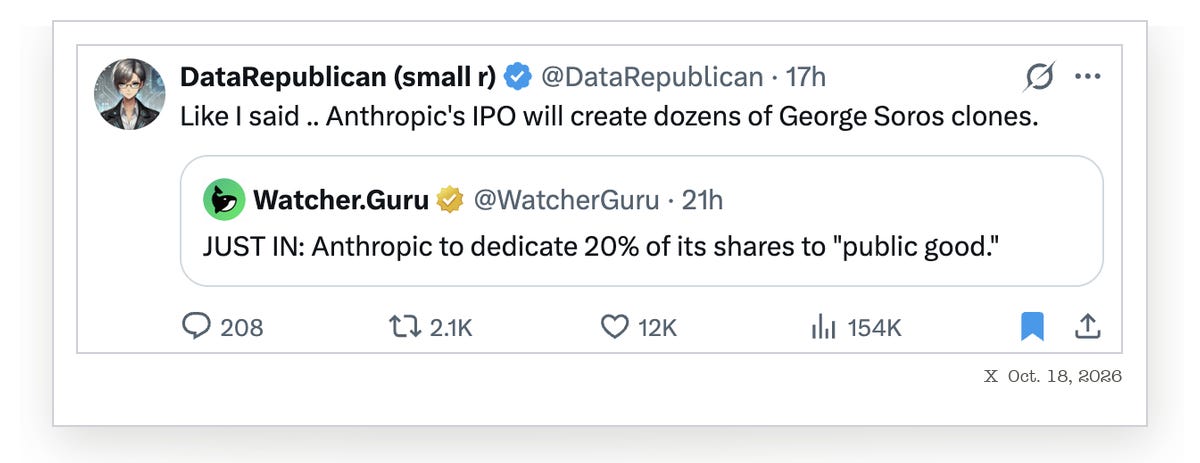
She may be onto something.
🔥 If it weren’t for double standards, the WSJ would have no standards at all. Unlike its suspicious scrutiny of Musk’s simple promise, the article did not probe all the inexplicable parts of Anthropic’s fuzzy pledge or call them “not immediately clear.” The Journal did not, for instance, ask “how the shares would be distributed, who would receive them,” or “when it might start.”
In Anthropic’s case, those are all fair questions. Unlike Musk’s clear promise, Anthropic’s announcement was chock full of complexity and dripping with lawyer weasel words. So it was telling that the Journal described Musk’s announcement as “not immediately clear.”
But the Journal implicitly noticed Anthropic’s fine print— by quoting the Space Billionaire. “Musk suggested Anthropic should give the shares directly to the public,” the Journal noted without additional comment. This, at last, was the real crux: Whether progressives and the government will keep their lucrative roles as charitable intermediaries, or whether the new Trump economy will delete the middleman.
A secondary point, also skipped by the Journal, was that Musk has no need to gift any part of his wealth away, much less an eye-watering $10 billion worth. Note that a gift is something freely given, without strings attached. Any transfer that comes with strings cannot properly be called a ‘gift,’ no matter how generous its intent.
Strings are how you control people.
Under the progressive model, charitable transfers come with strings of control, with legions of government bureaucrats administering the transfer programs and selectively enforcing complicated rules against various groups, creating a fierce competition between the interest groups to capture the bureaucracies.
All that charitable infrastructure disappears when donors can give stock directly to Americans and bypass the middlemen. Once the model takes off, it will spread. It could change everything.
That loud cracking noise is the sound of hundreds of federal agencies being bulldozed into the landfill of history. For the first time in our lives, we can see a possible future of individual empowerment, without a nanny state government micromanaging an increasingly helpless populace." .......
more Sayer Ji links:
“… My follow-up draws a parallel with Pandemic: How to Prevent an Outbreak, released January 22, 2020, just before Wuhan’s January 23 lockdown.
It also points to King Charles’s planned AI talks.
The recurring question is how media narratives can shape consent while influential institutions discuss the response. …
This is Piece 8 in a six-part series. Piece 1 documented the CCDH rebrand.
Piece 2 documented ControlAI’s role in Bernie Sanders’s AI bill.
Piece 3 documented Obama’s endorsement of a manufactured panic.
Piece 4 documented the London drafting of the Sanders bill.
Piece 5 documented the eight-year transatlantic pipeline.
Piece 6: documented the elite ratification stage.
Piece 7 documented Bill Gates and the Billion-Dollar AI Paradox.” …….

No comments:
Post a Comment