Thursday, April 28, 2022

The Twain Shall Meet: Happy Birthday, Actual President Ulysses S. Grant

"The past is a foreign country: they do things differently there."--L.P. Hartley

"There is not really any courage at all in attacking hoary or antiquated things, any more than in offering to fight one's grandmother. The really courageous man is he who defies tyrannies young as the morning and superstitions fresh as the first flowers. The only true free-thinker is he whose intellect is as much free from the future as from the past."--G.K. Chesterton

“One day he put aside his pencil and said there was nothing more to do.”--Mark Twain


Party Before Uni-Party!


Mark Twain did not write Actual President Grant's 'Memoirs'.  Like Actual President Reagan, his manuscripts still exist in his own handwriting.

Twain did edit the work, but his most important role was to arrive just in the nick of time. He convinced Grant not to sign an inferior publishing contract and secured a lucrative deal that provided for Grant's family. .......

Mark Twain on Ulysses S. Grant -(irishmanspeaks.com)

"He was a very great man and superlatively good."—Mark Twain: A Biography

❖ ❖ ❖

"I think the most interesting personality I ever encountered was General Grant. How and where he was so much larger than other men I had ever met I cannot describe. It was the same sort of feeling, I suppose that made my friend, Thomas Starr King, whilst listening to a celebrated preacher, turn to me and exclaim, “Whereabouts in that figure does that imperial power reside.” You had that feeling with Grant exactly."—Mark Twain Interview: Sydney Morning Herald, 1895

❖ ❖ ❖

"[W]hen we think of General Grant our pulses quicken and his grammar vanishes; we only remember that this is the simple soldier, who, all untaught of the silken phrase-makers, linked words together with an art surpassing the art of the schools, and put into them a something which will still bring to American ears, as long as America shall last, the roll of his vanished drums and the tread of his marching hosts."—Mark Twain Notebook, 1886

...so many of Grant’s former West Point friends became Confederate enemies and the wonderful gesture of Grant’s wife Julia who requested two of those Confederate generals to be pall bearers.".......
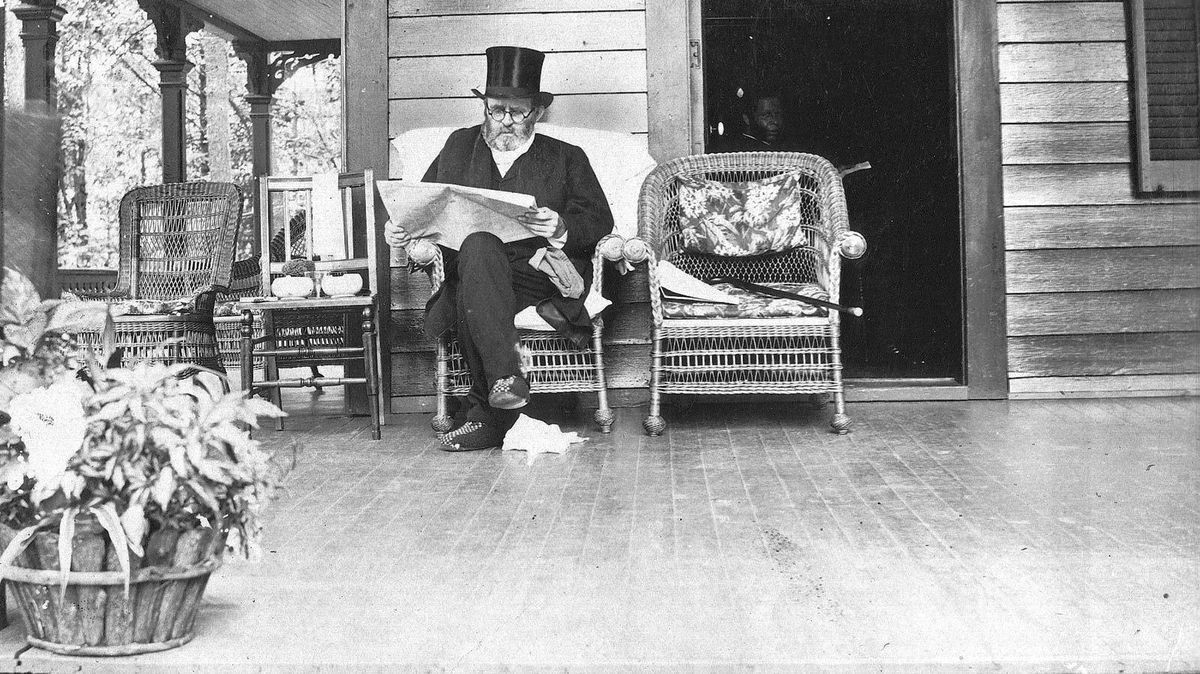
Mark Twain quotations - Ulysses Grant (twainquotes.com)

"I did not admire him so much for winning the war as for ending the war."- quoted in Abroad with Mark Twain and Eugene Field, Fisher
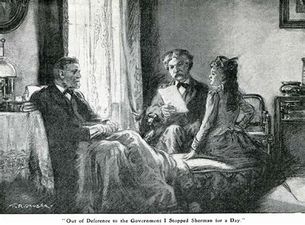
Illustration by Frederick Gruger from SUNDAY MAGAZINE, Dec. 1, 1907.
Ulysses Grant, Samuel Clemens and Susy Clemens

How Ulysses S. Grant and Mark Twain Rescued Each Other’s Fortunes - OZY | A Modern Media Company

"At the dinner in Grant’s honor, Twain was the final speaker in a series of interminable after-dinner toasts that had extended well past midnight, and the humorist decided to use his formidable wit to try to break up the usually stone-countenanced general. At one point, in the 19th century version of a Comedy Central roast, Twain irreverently conjured the image of a baby Grant, a headstrong infant determined to suck his own toes. “And if the child is but a prophecy of the man,” he injected, “there are mighty few who will doubt that he succeeded.”

It did the trick. “I fetched him! I broke him up, utterly!” Twain later informed his wife. “I shook him up like dynamite,” he told a good friend. “He sat there fifteen minutes & laughed and cried like the mortalest of mortals.”’

Ulysses S. Grant Quotes (Author of Personal Memoirs) (goodreads.com):

“No political party can or ought to exist when one of its corner-stones is opposition to freedom of thought and to the right to worship God “according to the dictate of one’s own conscience,” or according to the creed of any religious denomination whatever.”― Ulysses S. Grant, Personal Memoirs of U.S. Grant: All Volumes

“I am not aware of ever having used a profane expletive in my life; but I would have the charity to excuse those who may have done so, if they were in charge of a train of Mexican pack mules at the time. CHAPTER VIII.”― Ulysses S. Grant, Personal Memoirs of U.S. Grant: All Volumes

“It is possible that the question of a conflict between races may come up in the future, as did that between freedom and slavery before. The condition of the colored man within our borders may become a source of anxiety, to say the least. But he was brought to our shores by compulsion, and he now should be considered as having as good a right to remain here as any other class of our citizens.”― Ulysses S. Grant, Personal Memoirs of Ulysses S Grant, Includes Both Volumes

“During the day I was passing along the line from wing to wing continuously. About the centre stood a house which proved to be occupied by an old lady and her daughter. She showed such unmistakable signs of being strongly Union that I stopped. She said she had not seen a Union flag for so long a time that it did her heart good to look upon it again. She said her husband and son, being Union men, had had to leave early in the war, and were now somewhere in the Union army, if alive. She was without food or nearly so, so I ordered rations issued to her, and promised to find out if I could where the husband and son were.”― Ulysses S. Grant

“I believe . . . that if our country ever comes into trial again, young men will spring up equal to the occasion, and if one fails, there will be another to take his place.”― Ulysses S. Grant

“While a battle is raging one can see his enemy mowed down by the thousand, or the ten thousand, with great composure; but after the battle these scenes are distressing, and one is naturally disposed to do as much to alleviate the suffering of an enemy as a friend.”
― Ulysses S. Grant, Personal Memoirs of U.S. Grant: All Volumes

“When the men were all back in their places in line, the command to advance was given. As I looked down that long line of about three thousand armed men, advancing towards a larger force also armed, I thought what a fearful responsibility General Taylor must feel, commanding such a host and so far away from friends. The Mexicans immediately opened fire upon us, first with artillery and then with infantry. At first their shots did not reach us, and the advance was continued. As we got nearer, the cannon balls commenced going through the ranks. They hurt no one, however, during this advance, because they would strike the ground long before they reached our line, and ricochetted through the tall grass so slowly that the men would see them and open ranks and let them pass.”― Ulysses S. Grant, Personal Memoirs

“The Southern rebellion was largely the outgrowth of the Mexican war. Nations, like individuals, are punished for their transgressions. We got our punishment in the most sanguinary and expensive war of modern times. The 4th infantry went into camp at Salubrity in the month of May, 1844, with instructions, as I have said, to await further orders.”― Ulysses S. Grant, Personal Memoirs of U.S. Grant: All Volumes

“I believe it has never been my misfortune to be placed where I lost my presence of mind--unless indeed it has been where thrown in strange company, particularly of ladies.”― Ulysses S. Grant

“The darkest day of my life was the day I heard of Lincoln's assassination. I did not know what it meant. Here was the rebellion put down in the field, and staring up in the gutters...”― Ulysses S. Grant

“I would not have the anniversaries of our victories celebrated, nor those of our defeats made fast days and spent in humiliation and prayer; but I would like to see truthful history written. Such history will do full credit to the courage, endurance and soldierly ability of the American citizen, no matter what section of the country he hailed from, or in what ranks he fought. The justice of the cause which in the end prevailed, will, I doubt not, come to be acknowledged by every citizen of the land, in time. For the present, and so long as there are living witnesses of the great war of sections, there will be people who will not be consoled for the loss of a cause which they believed to be holy. As time passes, people, even of the South, will begin to wonder how it was possible that their ancestors ever fought for or justified institutions which acknowledged the right of property in man.”― Ulysses S. Grant, The Complete Personal Memoirs of Ulysses S. Grant

“I know only two tunes. One of them is 'Yankee Doodle' the other isn't.”― Ulysses S. Grant

“The framers were wise in their generation and wanted to do the very best possible to secure their own liberty and independence, and that also of their descendants to the latest days. It is preposterous to suppose that the people of one generation can lay down the best and only rules of government for all who are to come after them, and under unforeseen contingencies. At the time of the framing of our constitution the only physical forces that had been subdued and made to serve man and do his labor, were the currents in the streams and in the air we breathe. Rude machinery, propelled by water power, had been invested sails to propel ships upon the waters and been set to catch the passing breeze – but the application of steam to propel vessels against both wind and current, and machinery to do all manner of work had not been thought of. The instantaneous transmission of messages around the world by means of electricity would probably that day have been attribute to witchcraft or a league with the Devil. Immaterial circumstances had changed as greatly as material ones. We could not and ought not to be rigidly bound by the rules laid down under circumstances so different for emergencies so utterly unanticipated. The fathers themselves would have been the first to declare that their prerogatives were not irrevocable.”― Ulysses S. Grant, Memoirs and Selected Letters

“If we are to have another contest in the near future of our national existence, I predict that the dividing line will not be Mason and Dixon's but between patriotism and intelligence on the one side, and superstition, ambition and ignorance on the other.”― Ulysses S. Grant

“I have never advocated war except as means of peace, so seek peace, but prepare for war. Because war... War never changes. War is like winter and winter is coming.”― Ulysses S Grant

“Whatever may have been my political opinions before, I have but one sentiment now: that is, we have a government, and laws, and a flag, and they must all be sustained. There are but two parties now: traitors and patriots. And I want hereafter to be ranked with the latter.”― Ulysses S. Grant

Then, as now, sir, then as now.
Monday, April 25, 2022

Tell It to Me Straight, Doc Sowell: The Quest for Cosmic Justice

Q: How Red-Pilled are Americans Becoming?


A: Even Mike Tyson is reading Dr. Thomas Sowell’s “Basic Economics“.

Well, he's got ears to hear. Three of them.

Thomas Sowell | Speech "The Quest for Cosmic Justice" (tsowell.com)

"When you try to condense a book representing years of thought and research into a half-hour talk, a certain amount of over-simplification is inevitable.  With that understood, let me try to summarize the message of The Quest for Cosmic Justice in three propositions which may seem to be axiomatic, but whose implications are in fact politically controversial:

  1. The impossible is not going to be achieved.

  2. It is a waste of precious resources to try to achieve it.

  3. The devastating costs and social dangers which go with these attempts to achieve the impossible should be taken into account.

Cosmic justice is one of the impossible dreams which has a very high cost and very dangerous potentialities.

In a sense, proponents of "social justice" are unduly modest.  What they are seeking to correct are not merely the deficiencies of society, but of the cosmos. What they call social justice encompasses far more than any given society is causally responsible for.  Crusaders for social justice seek to correct not merely the sins of man but the oversights of God or the accidents of history.  What they are really seeking is a universe tailor-made to their vision of equality.  They are seeking cosmic justice. 

The rule of law, on which a free society depends, is inherently incompatible with cosmic justice.  Laws exist in all kinds of societies, from the freest to the most totalitarian.  But the rule of law-- a government of laws and not of men, as it used to be called-- is rare and vulnerable.  You cannot redress the myriad inequalities which pervade human life by applying the same rules to all or by applying any rules other than the arbitrary dispensations of those in power.  The final chapter of The Quest for Cosmic Justice is titled "The Quiet Repeal of the American Revolution"-- because that is what is happening piecemeal by zealots devoted to their own particular applications of cosmic justice.

They are not trying to destroy the rule of law.  They are not trying to undermine the American republic.  They are simply trying to produce "gender equity," institutions that "look like America" or a thousand other goals that are incompatible with the rule of law, but corollaries of cosmic justice.

 Because ordinary Americans have not yet abandoned traditional justice, those who seek cosmic justice must try to justify it politically as meeting traditional concepts of justice.  A failure to achieve the new vision of justice must be represented to the public and to the courts as "discrimination." Tests that register the results of innumerable inequalities must be represented as being the cause of those inequalities or as deliberate efforts to perpetuate those inequalities by erecting arbitrary barriers to the advancement of the less fortunate.

 In short, to promote cosmic justice, they must misrepresent what is happening as violations of traditional justice-- as understood by others who do not share their vision.  Nor do those who make such claims necessarily believe them themselves.  As Joseph Schumpeter once said: "The first thing a man will do for his ideals is lie."

The next thing the idealist will do is character assassination.  All those who disagree with the great vision must be shown to have malign intentions, if not deep-seated character flaws.  They must be "Borked," to use a verb coined in our times.  They must be depicted as "A Strange Justice" if somehow they survive the Borking process.  They must be depicted as having some personal "obsessions" if they carry out the duties they swore to carry out as a special prosecutor.  In short, demonization is one of the costs of the quest for cosmic justice.

The victims of this process are not limited to those targeted.  The society as a whole loses when its decisions are made by character assassination, rather than by rational discussion, and when its pool of those eligible for leadership is drained by the exodus of those who are not prepared to sacrifice their good name or subject their family to humiliations for the sake of grasping the levers of power.  This loss is not merely quantitative, for those who are willing to endure any personal or family humiliations for the sake of power are the most dangerous people to trust with power.

In a sense, those caught up in the vision of cosmic justice are also among its victims.  Having committed themselves to a vision and demonized all who oppose it, how are they to turn around and subject that vision to searching empirical scrutiny, much less repudiate it as evidence of its counterproductive results mount up?

Ironically, the quest for greater economic and social equality is promoted through a far greater inequality of political power.  If rules cannot produce cosmic justice, only raw power is left as the way to produce the kinds of results being sought.  In a democracy, where power must gain public acquiescence, not only must the rule of law be violated or circumvented, so must the rule of truth.  However noble the vision of cosmic justice, arbitrary power and shameless lies are the only paths that even seem to lead in its direction."....... 


Thomas Sowell (jewishworldreview.com): High Stakes in Virginia:
"If you have a strong stomach, read about the 1915 atrocities against the Armenians in Turkey, "ethnic cleansing" in the Balkans, or the reciprocal atrocities between the Sinhalese and Tamils during their civil war in Sri Lanka.

Do not kid yourself that this cannot happen in America. The relations between the Sinhalese and Tamils in Sri Lanka were once held up to the world as a model of intergroup harmony.

They got along better than blacks and whites have ever gotten along in the U.S. But then a talented demagogue polarized the country with group-identity politics, to get himself elected prime minister.

Once he was elected, he was ready to moderate his position. But you cannot just turn group hatred on and off, like a light bulb. He was assassinated and the hatred continued on.".......

 Thomas Sowell Tribute Site(@ThomasSowell) / Twitter:

"The most basic question is not what is best but who shall decide what is best."

“It is amazing how much panic one honest man can spread among a multitude of hypocrites.”

“Inflation is in effect a hidden tax. The money that people have saved is robbed of part of its purchasing power, which is quietly transferred to the government that issues new money.”

“Each new generation born is in effect an invasion of civilization by little barbarians, who must be civilized before it is too late.”

“If you put $1,000 in your piggy bank in 1960 and took it out to spend in 2000, you would discover that your money had, over time, lost 80 percent of its value.”

“Virtually no idea is too ridiculous to be accepted, even by very intelligent and highly educated people, if it provides a way for them to feel special and important.”

“Historians of the future will have a hard time figuring out how so many organized groups of strident jackasses succeeded in leading us around by the nose and morally intimidating the majority into silence.”

Silent no more.

comment image

Doc Sowell and Iron Mike agree:

“Fight back. That spirit is the best birthday present for America.”

More:

“Much of the social history of the Western world over the past three decades has involved replacing what worked with what sounded good.”

“Freedom has cost too much blood and agony to be relinquished at the cheap price of rhetoric.”

"If you want to understand the fatal dangers facing America today, read "The Gathering Storm" by Winston Churchill. The book is not about America, the Middle East or nuclear missiles. But it shows Europe's attitudes and delusions — aimed at peace in the years before the Second World War — which instead ended up bringing on that most terrible war in all of human history. ... Reading about the decline and fall of the Roman Empire, and the widespread retrogressions of Western civilization that followed, was an experience that was sobering, if not crushing. Ancient history in general lets us know how long human beings have been the way they are, and dampens giddy zeal for the latest panaceas, despite how politically correct those panaceas may be."

“Nothing is too gross when promoting racial hysteria in an election year. Veteran Democrat Congressman Charlie Rangel from Harlem declared that Republicans “don’t disagree — they hate!” According to Rangel, “Some of them believe that slavery isn’t over and that they won the Civil War!” Republicans did win the Civil War. That’s why there is no more slavery.”

“If you are not prepared to use force to defend civilization, then be prepared to accept barbarism.”

"Hillary Clinton's idea that we have to see the world from our adversaries' point of view — and even "empathize" with it — is not new. Back in 1938, British Prime Minister Neville Chamberlain said, "I have realized vividly how Herr Hitler feels." Ronald Reagan, however, made sure our adversaries understood how we felt. Reagan's approach turned out a lot better than Chamberlain's."

“When people get used to preferential treatment, equal treatment seems like discrimination.”

“One of the common failings among honorable people is a failure to appreciate how thoroughly dishonorable some other people can be, and how dangerous it is to trust them.”  

“Ronald Reagan had a vision of America. Barack Obama has a vision of Barack Obama.”

“It was Thomas Edison who brought us electricity, not the Sierra Club. It was the Wright brothers who got us off the ground, not the Federal Aviation Administration. It was Henry Ford who ended the isolation of millions of Americans by making the automobile affordable, not Ralph Nader. Those who have helped the poor the most have not been those who have gone around loudly expressing 'compassion' for the poor, but those who found ways to make industry more productive and distribution more efficient, so that the poor of today can afford things that the affluent of yesterday could only dream about.”

"The history of the 20th century is full of examples of countries that set out to redistribute wealth and ended up redistributing poverty."

“As a young Marxist in college during the 1950s heyday of the anti-Communist crusade led by Senator Joseph McCarthy, I had more freedom to express my views in class, without fear of retaliation, than conservative students have on many campuses today.”

"When loan approval rates are not cited, but loan denial rates are, that creates a larger statistical disparity, since most loans are approved. Even if 98 percent of blacks had their mortgage loan applications approved, if 99 percent of whites were approved than by quoting denial rates alone it could be said that blacks were rejected twice as often as whites.” [Which is how you lie with statistics--ed.]

"Capitalism is not an ‘ism.’ It is closer to being the opposite of an ‘ism,’ because it is simply the freedom of ordinary people to make whatever economic transactions they can mutually agree to."

“Guns are completely inappropriate for the kind of sheep-like people the anointed envision or the orderly, prepackaged world in which they are to live. When you are in mortal danger, you are supposed to dial 911, so that the police can arrive on the scene some time later, identify your body, and file reports in triplicate.”  

"By the end of the 20th century, “liberals” had again discredited themselves, to the point where they went back to calling themselves “progressives” to escape their past, much as people do when they declare bankruptcy."

"Whether Barack Obama is simply incompetent as president or has some hidden agenda to undermine this country, at home and abroad, he has nearly everything he needs to ruin America, including a fool for a vice president."


"Arbitrary power is ugly and vicious, regardless of what pious rhetoric goes with it. Freedom is not free. You have to fight for it or lose it. But is our generation up to fighting for it?"--Thomas Sowell

Saturday, April 23, 2022

"The True Origins of ‘America First’" by Angelo Codevilla on John Quincy Adams

“Who the hell do they think they are? Stop pretending. Realize that you enjoy the rights God gave you only to the extent that your fellow ex-citizens recognize them, and that your only hope of continuing enjoyment lies in leaguing with them, on turning your back on the oligarchy and on effectively living republican lives with similarly minded people.”--Professor Angelo Codevilla, American

The True Origins of ‘America First’ › American Greatness (amgreatness.com)

This essay is adapted from “America’s Rise and Fall Among Nations: Lessons in Statecraft from John Quincy Adams” (Encounter, 288 pages, $30.99).
John Quincy Adams is the font of American geopolitical thought. Today, lesser men fail to grasp his teaching that alignment of interests among nations can only be creatures of time and circumstance.
"... Americans have thought themselves fortunate that they or their ancestors had distanced themselves from the rest of European civilization—and not just geographically. America was their final destination. They had not come on the way to anywhere else. Few went back. They left old quarrels and did not come to start new ones. They came because they expected America to be different, a nearly empty land where they would have peace, freedom, and the bread that their hands earned. And that is why Americans’ relations with foreigners were always premised on appreciation for what made America different. Putting America First meant more than natural self-interest. It meant putting a better, demonstrably different way of life first. ...for most Americans, the overriding objective of American foreign policy has ever been, first of all, protecting a decent, autonomous way of life for our citizens. 

Putting America First always meant defending that way of life. 

The Founders

In the first six of the Federalist Papers, Alexander Hamilton, James Madison, and John Jay summarized the opinions about foreign affairs common in the mass media of the day—sermons and newspapers. Foremost, Americans wanted peace. In Federalist 3, Jay wrote that peace being Americans’ objective, we must neither insult nor injure foreigners. That means minding our own business. And in Federalist 4, he wrote that peace would also depend on readiness to punish foreigners’ interference in our affairs. In Federalist 6, Hamilton pointed out that since wars arise from ubiquitous, unpredictable causes and circumstances, Americans must be ever ready to fight. The founders also knew that, as other nations were surely going to fight among themselves, Americans had better be careful lest they be drawn into others’ quarrels. More than a century later, Theodore Roosevelt summed all this up in homespun terms: “Speak softly and carry a big stick.”

No sooner had the Constitution come into being than the quarter century of the French Revolution’s wars became the crucible in which the American people’s international character was forged. George Washington’s 1793 proclamation of neutrality in those wars, seconded by Alexander Hamilton’s Pacificus and Americanus essays, and young John Quincy Adams’ Marcellus, laid the theoretical base. Washington’s 1796 farewell address warned against the domestic temptations that entice us to set aside our geographic good fortune and common sense. “Why quit our own to stand on foreign ground?” Washington asked. “Observe good faith and justice toward all nations,” he adjured. He argued that neutrality with regard to others’ business is the other side of intense focus on our own. By contrast, confusing other nations’ interests with our own, he said, sets us against one another.

Since Washington’s statecraft aimed foremost at uniting Americans, he was careful—even when waging a war in which a significant part of the population sided with the enemy—to treat all as if they were loyal citizens.

Washington never tired of urging his fellow citizens to have arm’s-length relationships with foreign nations and to back them up with a respectable army. His successor, John Adams, fathered the U.S. Navy. The lead ship thereof, the U.S.S. Constitution, is still in commission.

In 1777, John Adams took his son, 10-year-old John Quincy, on his diplomatic mission to secure military aid from France and loans from Holland. The boy grew up fast—mastering perfect French and Dutch, helping his father, and conversing with statesmen. In 1781, when Charles Francis Dana was appointed to represent the United States in Saint Petersburg, 14-year-old J. Q. Adams accompanied him as his secretary. Since Dana spoke no French—the language of Russia’s elites—J. Q. effectively transacted the embassy’s business for two years. In 1784, when John Adams became America’s representative to King George III, 17-year-old John Quincy functioned as his father’s deputy. That was before entering Harvard, and then studying law. In 1794, George Washington appointed John Quincy Adams minister to the Netherlands. Successive presidents then sent him to represent the United States in Prussia, Russia, and Great Britain. In the course of these duties, he also became fluent in German, Russian, Italian, and Spanish. Since earliest youth, he had read the Latin and Greek classics.

As secretary of state (1817–1825), J. Q. Adams summed up and personified what America’s unique people would have to do to live peacefully among diverse nations. As we will see, although Adams did not invent any principles of statecraft, neither adding to nor subtracting from what Washington, Hamilton, and his father had prescribed, his dispatches, diary, and memoirs specified and applied their principles in a way that constitutes a comprehensive course of instruction for international relations in general, and for American statecraft in particular.

Adams shared, specified, and conveyed to his successors the founding generation’s fundamental interest in preserving and enhancing America’s own character. He sought occasions for reminding other nations—but especially our own—of the principles that make America what it is. Doing this encourages us to carefully consider how any decision we make in international affairs affects what is most important to ourselves as well as to others.

Adams is the font of American geopolitical thought. The reader should pay particular attention to Adams’ primordial distinction between America’s own interests—hence the “causes” for which Americans might fight—as well as to the (largely geographic) bases for evaluating the extent to which any cause or interest may be our own. The peoples on our borders and on the islands around us concern us most, followed by the oceans, then the rest of the world. Diplomatic experience had also taught Adams that, where the interests of nations coincide, negotiated agreements are scarcely necessary, and that when interests do not coincide, agreements are not worth the paper they are written on. That is why Adams practiced and taught a meticulous sort of diplomacy that aims at the mutual clarification of objectives.

John Quincy Adams considered the treaty that extended the United States’ border to the Pacific Ocean to have been his great achievement, alongside having established good relations with the governments of Britain, Russia, and so forth, in full acknowledgment of the radical differences between their regimes and ours. Adams had not invented the principle of mutual non-interference. That principle is, after all, the essence of the 1648 treaties of Westphalia. But Adams’ formulation of the Monroe Doctrine established non-interference as American foreign policy’s operational core.

The Legacy

Perhaps nothing shows how thoroughly Adams’ ways had conquered American statesmen’s minds as does his successor Andrew Jackson’s conduct. Jackson had beaten Adams in a bitter election. No two Americans could have been more different. Nevertheless, like Adams, Jackson combined commitment to peace and harmony with near-reflexive retaliation to physical attacks on Americans and on America’s honor. Like Adams, Jackson was about enhancing America. But despite being a man of the sword, his attempts to gain additional territory from Mexico were limited to offers of purchase, just as Adams’ had been. And though President Jackson owned slaves, his refusal to admit Texas as a slave state and his forceful stand against South Carolina’s attempt to nullify federal law were as forceful as Adams’ would have been. America’s greatness had been Adams’ great objective—a greatness that could not be purchased by unjust war or by any sacrifice of its principles.

In short, John Quincy Adams had codified the founding generation’s principles in foreign affairs into a set of practices by statesmen and expectations on the part of the public. That is why even the far-lesser statesmen in the years preceding the Civil War adhered to the Adams paradigm, if—as in the case of the Mexican War (1846–48)—only ineptly and hypocritically. To wit: President Polk did not intend to start the Mexican War; he resisted pressures to take over Mexico for nation-building, and paid Mexico the price he would have paid to purchase what he conquered. Meanwhile, presidents between Jackson and Lincoln delivered peaceful adjustment of interests with the rest of mankind.

Abraham Lincoln’s first major speech expressed his quintessentially American approach to international affairs: “All the armies in the world led by a Bonaparte, disposing of the earth’s treasure, our own excepted, could not take a drink from the Ohio or make a track on the Blue Ridge in a trial of a thousand years.” Only Americans, he said, can truly hurt America. And they can do that only by putting their own passions and interests against America itself. That is why, as discord led to secession, Lincoln adjured the South not to start the war. Both Northerners and Southerners, he said, must think of themselves as Americans, first.

Because Lincoln kept in mind Washington’s commitment to treating fellow Americans as citizens, he aimed his conduct of the Civil War at reconciliation from start to finish. All manner of war aroused Lincoln’s deepest fears. “Peace among ourselves and with all nations” was the star by which he steered."

comment image
Skipping now to the closing paragraphs, we see the kind of political arguments which caused the FBI to stalk and bait the Professor at his lectures. Codevilla then contracted serious COVID, and when he started recovering, was run down on the street by a "drunk" driver.  

"The third time is enemy action," said Goldfinger...
"The War on Terror, against no one in particular and with no concrete objective, became a vehicle by which persons in power advanced personal, corporate, and partisan interests. Advantage over domestic competitors was high among these. Quickly, they applied the label “terrorist” to their domestic competitors, and increasingly turned that war’s extraordinary powers against other Americans. No more thorough negation of the Washington/Adams approach to war can be imagined.

In short, the American people, having experienced foreign policy as an endless drain of blood, treasure, and honor detached from and even opposed to the common good, have withdrawn support, even respect, for their government’s role among nations.

America’s Real Circumstances

The American people and international circumstances of today could hardly have been imagined only a few decades ago. They have come about in no small part due to how America’s progressive ruling class has thought and ruled. Surely, the pitiful results should prevent this ruling class from continuing as it has. The end of the long Cold War emergency should have led them to reset foreign policy onto solid, timeless grounds. Instead, freed from the last vestiges of responsibility, they gave free rein to their progressive tendencies which, over the past 30 years, have neutered the United States of America among nations.

During the past three decades, the international environment has become ever more hostile to America. In Russia, communism’s collapse had been followed by a wave of pro-Western, pro-American sentiment. But U.S. statesmen’s impotent preaching combined with incompetent involvement with the former Communist Party bosses that were privatizing the country into their own pockets quickly made Russians anti-American for the first time in history.

In 1990, China had loomed small. Its economy was worth $367 billion while America’s was about $6 trillion. Neither was China a military threat. By 2020, China was a major power. In sum, most of the security Americans had earned in the Pacific War of 1941-1945 was gone.

By 2020, Europe had long since ceased to be America’s ally. Anti-Americanism had been growing among Europe’s ruling classes since the 1960s. Yes, relations between its ruling classes and America’s continued to be close. But, increasingly, as the ruling classes on both sides of the Atlantic were beset by challenges from their own people—as neither set of elites could nor would marshal popular support for their transatlantic partners—they related to each other on ever-narrower bases.

In the new century, as America’s progressive statesmen lost war after endless war, as the reservoir of respect for America dried up ...In short, the U.S. ruling classes ceased to respect the American people who, in turn, have ceased to respect their rulers. More fundamentally, both rulers and ruled have become very different from the Americans who bestrode the globe in the mid-20th century. They also drew on the reservoir of respect that Americans had built up among nations. These reservoirs have never been lower. It remains to be seen whether any foreign policy for today’s America is possible. No task is more important, or more difficult to accomplish, than recovering respect.
Simple to conceive, the principles by which early Americans earned respect have always been hard to practice. “Shut up about other people’s business!” has always been the bedrock principle of international communication. John Jay did not make it so in Federalist 3; nor did George Washington in his farewell address; nor John Quincy Adams’ instructions with regard to South America’s and Greece’s struggles for independence; nor Theodore Roosevelt’s rebukes to imperialists. For these statesmen, minding their own business was second nature.

These leaders recalled Americans to that principle precisely because many in their time were paying insufficient attention to it while others violated it to showcase their pretenses to virtue. In our time—progressives having made loose talk a virtue—the beginning of international seriousness must consist of restricting official comments strictly to America’s own business, speaking unadorned truth insofar as it concerns ourselves, saying what you mean and meaning what you say. Alas, only serious people can do that.

John Quincy Adams did not install peace as international relations’ primary goal or discover that mutual noninterference is the foundation of peace. That primacy and that principle happen to be the foundation of the modern (post-1648) international system. J. Q. Adams’ formulation of the Monroe Doctrine simply made that principle into a system of priorities adapted to the United States of America’s peculiar regime and geographic circumstances. Since these peculiarities have not changed, the order of those priorities remains intact: America First, then everything else in decreasing order of its influence on America.

But just as 200 years ago even statesmen of Thomas Jefferson’s and James Monroe’s caliber were attracted to the mirage of greatness through alliances, so today lesser men find it difficult to grasp John Quincy Adams’ teaching that alignment of interests among nations can only be creatures of time and circumstance. This means that although alliances are often keys to events, any people may pursue with any level of confidence only such objectives as they can achieve unilaterally.
The men who made America great, the men on Mount Rushmore, would counsel us strongly to decide unilaterally on our international affairs, and to do so by deliberation through our elected representatives—by their votes and by ours. The importance of doing so, they would tell us, transcends the matters at hand because it reaffirms and reminds us of the most basic of all political facts: our independence—meaning our collective liberty and responsibility for being what we were and should be again: different from other peoples, fortunate for that difference, grateful for it, and committed to maintaining it.

Never has it been so important to remember and reaffirm that our autonomy depends on our unity as Americans.".......................................................
A very long and very excellent essay by the late patriot Prof. Codevilla (code-vill-ah). Read it all. 


The Unblinken
Related: 

"The US military ran the entire operation to sink the Moskva, including running the tracking of the ship via a P-8 Poseidon surveillance aircraft, which then handed off fire solutions to the Ukrainians who were all trained by the US military as well. Thus, the United States provided the weapons, the training, the tracking and the fire solution to sink the Moskva. All Ukraine did was press the “fire” button, essentially. This is so widely known know that it’s even being reported by the UK Daily Mail. It reports:

REVEALED: US maritime surveillance plane was over Black Sea minutes before Russian flagship Moskva was ‘hit by Ukrainian missiles’
A P-8 Poseidon surveillance aircraft was patrolling the coast before the attack

The high-tech jet can spot ships on radar at ranges of more than 100 miles…  The US Navy used its new marine surveillance aircraft to provide accurate targeting data to Ukrainian forces to sink the Russian Black Sea flag ship Moskva on April 13.""

"Additionally, Russia’s defense ministry said on Saturday that its forces had shot down a Ukrainian Su-25 fighter jet and destroyed three MI-8 helicopters at an airfield in Ukraine’s Kharkiv region."
Specialist Bishop E. Evans never should have been put in the position of rescuing The Big Guy's fentanyl mules and human cargo. The river didn't kill him. The $wamp did.
Well, they did it to us.
Just following orders from Beijing.
If it happened, we wouldn't know which government attacked us. Although the American Gumment has already attacked us twice with a Virus/Vaxx tag-team.

Biden is China’s Colonial Governor, their Proconsul of America and a Wholly-Owned Appendage of Chairman Xi’s scrotum.

And his entire China Cabinet, too.

Biden: "In the U.S. military, every vehicle is going to be climate-friendly. We're spending billions of dollars to do it."đŸ¤¦‍♂️ | Not the Bee 

BIDEN: “We’re going to start the process for every vehicle in the United States military, every vehicle is going to be climate-friendly.”

TRANSLATION: “We’re going to start the process for every vehicle in the United States military, every vehicle is going to have Chinese batteries and computer systems that can be disabled from Shenzhen–just like a CheatWare Voting Machine!”

They're charging us for our own Ethnic Cleansing.

"Your Swamp does not 
amuse us."

Secretary of State John Quincy Adams in an 1819 letter to Herr von Fiirstenwarther of Germany, who was seeking government favors for coming here:
“Emigrants…coming here, are not to expect favors from the governments. …They come to a life of independence, but [also] to a life of labor—and, if they cannot accommodate themselves to the character--moral, political, and physical, of this country, with all its compensating balances of good and evil, the Atlantic is always open to them, to return to the land of their nativity and their fathers.”
He watched the Battle of Bunker Hill from atop the barn of his parents, John and Abigail Adams. At 10, he was in the courts of Europe with father John. At 14, he was already a Revolutionary diplomat. Ambassador to Russia, Prussia, the Netherlands, England. Lawyer. Harvard professor. Spoke many languages including Latin. State senator then US senator. The only Federalist to support the Louisiana Purchase. Supported Clay's American System of commerce. Secured Florida after his future nemesis Andy Jackson's victories there, wrote several peace treaties including the War of 1812, and as Secretary of State, he authored the Monroe Doctrine. Won the presidency, then 9 terms as a House member, breaking the House's Gag Rule on abolitionism, winning freedom for the ship Amistad's slaves in the Supreme Court, he established the Smithsonian and raised Diplomat Charles Frances Adams. And, yes, he had a pet alligator.

You see, America once had a Ruling Class that was worth a damn. No more.
Oration - July 4th- 1837 - WallBuilders

"Why is it, Friends and Fellow Citizens, that you are here assembled? Why is it, that, entering upon the sixty-second year of our national existence, you have honored with an invitation to address you from this place, a fellow citizen of a former age, bearing in the records of his memory, the warm and vivid affections which attached him, at the distance of a full half century, to your town, and to your forefathers, then the cherished associates of his youthful days? Why is it that, next to the birth day of the Savior of the World, your most joyous and most venerated festival returns on this day?—And why is it that, among the swarming myriads of our population, thousands and tens of thousands among us, abstaining, under the dictate of religious principle, from the commemoration of that birth-day of Him, who brought life and immortality to light, yet unite with all their brethren of this community, year after year, in celebrating this the birthday of the nation?

Is it not that, in the chain of human events, the birthday of the nation is indissolubly linked with the birthday of the Savior? That it forms a leading event in the progress of the gospel dispensation? Is it not that the Declaration of Independence first organized the social compact on the foundation of the Redeemer’s mission upon the earth? That it laid the cornerstone of human government upon the first precepts of Christianity, and gave to the world the first irrevocable pledge of the fulfilment of the prophecies, announced directly from Heaven at the birth of the Savior and predicted by the greatest of the Hebrew prophets six hundred years before?
Cast your eyes backwards upon the progress of time, sixty-one years from this day; and in the midst of the horrors and desolations of civil war, you behold an assembly of Planters, Shopkeepers and Lawyers, the Representatives of the People of thirteen English Colonies in North America, sitting in the City of Philadelphia. These fifty-five men on that day, unanimously adopt and publish to the world, a state paper under the simple title of ’A Declaration’.
The object of this Declaration was two-fold.
First, to proclaim the People of the thirteen United Colonies, one People, and in their name, and by their authority, to dissolve the political bands which had connected them with another People, that is, the People of Great Britain.
Secondly, to assume, in the name of this one People, of the thirteen United Colonies, among the powers of the earth, the separate and equal station, to which the Laws of Nature, and of Nature’s God, entitled them.
comment image
Mincing Quincys-UPDATE: Soros and Koch have spawned, creating a new org called the Quincy Institute, dedicated to destroying everything John Quincy Adams worked his whole life to build. He was an American patriot, not a Tower-of-Babel Globalist. In a town where the Anti-Trust think-tanks are funded by Google, it's not surprising that a Nazi art-dealer and his best customer would collude to steal John Quincy's good name. If they happen to quote JQA saying "[America] goes not abroad, in search of monsters to destroy", it is only to protect the Ayatollah or their profits, not you.

Don't be fooled.

"AND NOW, FRIENDS AND COUNTRYMEN, if the wise and learned philosophers of the elder world, the first observers of nutation and aberration, the discoverers of maddening ether and invisible planets, the inventors of Congreve rockets and Shrapnel shells, should find their hearts disposed to enquire what has America done for the benefit of mankind?

Let our answer be this: America, with the same voice which spoke herself into existence as a nation, proclaimed to mankind the inextinguishable rights of human nature, and the only lawful foundations of government. America, in the assembly of nations, since her admission among them, has invariably, though often fruitlessly, held forth to them the hand of honest friendship, of equal freedom, of generous reciprocity.

She has uniformly spoken among them, though often to heedless and often to disdainful ears, the language of equal liberty, of equal justice, and of equal rights.

She has, in the lapse of nearly half a century, without a single exception, respected the independence of other nations while asserting and maintaining her own.

She has abstained from interference in the concerns of others, even when conflict has been for principles to which she clings, as to the last vital drop that visits the heart.

She has seen that probably for centuries to come, all the contests of that Aceldama the European world, will be contests of inveterate power, and emerging right.

Wherever the standard of freedom and Independence has been or shall be unfurled, there will her heart, her benedictions and her prayers be.

But she goes not abroad, in search of monsters to destroy. She is the well-wisher to the freedom and independence of all. She is the champion and vindicator only of her own.

She will commend the general cause by the countenance of her voice, and the benignant sympathy of her example.

She well knows that by once enlisting under other banners than her own, were they even the banners of foreign independence, she would involve herself beyond the power of extrication, in all the wars of interest and intrigue, of individual avarice, envy, and ambition, which assume the colors and usurp the standard of freedom.

The fundamental maxims of her policy would insensibly change from liberty to force.... She might become the dictatress of the world. She would be no longer the ruler of her own spirit....

Her glory is not dominion, but liberty. Her march is the march of the mind. She has a spear and a shield: but the motto upon her shield is, Freedom, Independence, Peace. This has been her Declaration: this has been, as far as her necessary intercourse with the rest of mankind would permit, her practice."--John Quincy Adams, 1821
Despite John Quincy Adams' best efforts, we live in a dictatorship. This IS an American Dictatorship, even if they still feel the need to try and hide it.

The important thing to know is this: EVERY ACTION TAKEN BY THIS GOVERNMENT OF OCCUPATION IS DESIGNED ULTIMATELY TO DESTROY AMERICA. 

Now you're a foreign policy expert, too. 

In 1775, as a child in "the eighth year of my age", John Quincy climbed to the top of his parents' barn to witness the Battle of Bunker Hill and begin his part in that Mighty Revolutionary Struggle for American Freedom. Our freedom.

We're halfway through the hayloft and headed north.

Look up. Look up.


Author archive: Angelo Codevilla › American Greatness (amgreatness.com)

Angelo Privilege by Julie Ponzi
"My last long conversation with Angelo was just before the recent 9/11 anniversary, when we discussed his plans for future articles and what was happening in the world. He insisted that what was necessary at this crucial moment in American politics was leadership. He seemed confident that our crisis also announces opportunities. The greatest challenges offer the greatest possibilities to display human excellence, and thus will invite a statesman of real ambition and ability to emerge and remind Americans of what makes us unique among the peoples of the Earth: our instinct (if not always our understanding) that we are and ought to be the sovereigns of our own destiny. Our ruling-class oligarchs have supplanted that sovereignty through an administrative state that does their bidding while claiming to adorn itself in the forms and trappings of constitutionality. Yet their open contempt for our actual Constitution and its purposes proves only how difficult self-government is to achieve and maintain. Freedom under the law is not the usual way of things in this world. It is our privilege to fight to reestablish and maintain it.".......